
memory
Welcome to Memory
Theatre entered this conflict not to judge, but to bring different voices together. Artists uncovered silenced stories, confronted family memories with secret-police files, gave witnesses the stage, and tested the myths shaping Polish identity.
Here, the past gains voice, movement, and a living body. What do you remember — and can you listen when another story challenges your own? Follow the cracks. They reveal who built the story, whom it protects, and whom it leaves out.
CHAPTER 01
After the Breakthrough
1989 — 1994
After 1989, Poland’s political order — and its familiar story of the past — began to fracture. For some, the transition brought freedom, while for others it brought insecurity and loss. History became contested ground.
(Key event)
1980
The political transformation

Piesza Pielgrzymka Diecezji Gorzowskiej na Jasną Górę; RMN Zielona Góra; Arystoteles; Arystoteles (CC0 1.0); 1988.
In 1989, Poland experienced a peaceful end to the communist system. The Round Table talks led to the legalisation of Solidarity, partly free elections, and the government of Tadeusz Mazowiecki. The breakthrough did not, however, create a shared story of victory. For some, it demonstrated political maturity and opened the way to the free market; for others, it was an agreement among former elites and the beginning of unemployment and inequality.
The transformation abolished censorship and transferred many theatres to local authorities. In Był sobie Andrzej, Andrzej, Andrzej i Andrzej (Once There Was Andrzej, Andrzej, Andrzej and Andrzej), Strzępka and Demirski reckoned with the costs of reform, while the musical 1989 constructed a myth of peaceful revolution. Theatre does not settle this dispute; it allows both the winners and the losers to speak.

31 August 1980
The August Agreements
Workers’ strikes forced the communist authorities to permit the creation of the independent Solidarity trade union. The mass social movement that emerged from it laid the political foundations for the breakthrough of 1989.

1 January 1990
Launch of the Balcerowicz Plan
The reform package initiated a rapid transition from a centrally planned economy to a market economy. The recession, unemployment, and factory closures explain both the social costs of the transformation and the later divisions in its assessment.

1 May 2004
Poland joins the European Union
Accession confirmed Poland’s turn towards Western political and economic institutions. It opened new opportunities for development and migration, becoming a crucial long-term consequence of the transformation.
(INSTITUTION)
1990
Grodzka Gate –
NN Theatre Centre
How can one tell the story of a community whose world was destroyed and whose traces have almost disappeared from the city?
The “Grodzka Gate – NN Theatre” Centre answers this question by combining documentation, education, and art. It emerged in 1990 from an alternative theatre in Lublin and became a municipal cultural institution eight years later. Its home — a former passage between the Christian Old Town and the Jewish district of Podzamcze — set the direction for its work. The Centre collects witness testimonies, photographs, and documents of old Lublin and makes them available in a digital archive. History, however, does not remain confined to the collection.
Grodzka Gate has retained a theatrical way of thinking in its historical work. The collected materials become the substance of exhibitions, educational activities, and commemorative mysteries. In the exhibition Lublin. Memory of the Place and in actions staged on the site of the former Podzamcze district, participants listen to voices and read out names, experiencing the painful absence of a district that no longer exists.
The Centre does not attempt to recreate the lost world. It turns the city into a stage on which that absence can be seen, heard, and recognised as part of contemporary Lublin. Here, memory means responsibility for the traces of a history that its victims can no longer recount.
.jpg)
Brama Grodzka, Lublin; Marcin Białek; Marcin Białek / derivative work: Mogadir, CC BY-SA 3.0; 2013.
Anonymous artists inspired the name
The name “NN Theatre” refers to anonymous medieval artists who remained in the shadow of their works.
More than 143,000 digital objects
The Centre’s Multimedia Library provides access to more than 143,000 photographs, documents, recordings, and other digital objects.
Thousands of letters to Henio
Since 2005, young people from Poland and many other countries have written thousands of letters to Henio Żytomirski, a Jewish boy murdered during the Holocaust.
(ARTIST)
Tadeusz Słobodzianek
Tadeusz Słobodzianek is among the artists who, after 1989, redirected Polish drama towards a silenced past divided into conflicting narratives. Rather than reconstructing history, he examines how it turns into collective memory, religious myth, and private biography. He draws on testimonies, reportage, and real-life stories, but confronts them with legend and theatrical stylisation.
The document therefore does not close down the meaning of events; it enters into conflict with the stories through which communities explain their own past. His characters try to find their place between personal experience and the role assigned to them by history.
Prorok Ilja (Prophet Ilya) portrays an Orthodox community on the Polish-Belarusian border seeking salvation in myth. Nasza klasa (Our Class), which grew out of the debate about the murder of Jews in Jedwabne, follows Polish and Jewish schoolchildren through successive decades of violence, retaliation, and denial. In Historia Jakuba (Jacob’s Story), the memory of the Holocaust returns through the fate of a Catholic priest who discovers his Jewish origins.
Słobodzianek made disputes over Polish memory the material of contemporary drama. He does not reconcile them in a single version of the past, but asks about the right to speak and the differences between the responsibility of perpetrators, witnesses, and victims.

Tadeusz Słobodzianek was born in 1955 in Yeniseysk, Siberia, where his parents had been exiled, and grew up in Białystok.
The Drama Laboratory, which he founded in 2003, became a place for developing new Polish plays and supporting emerging playwrights.
The world premiere of Nasza klasa (Our Class) took place at London’s National Theatre in 2009, a year before the first Polish production.
(PERFORMANCE)
1993
Carmen Funebre

Carmen Funebre is an outdoor performance inspired by the war in the former Yugoslavia and the testimonies of refugees from Bosnia. It depicts people terrorised, humiliated, and driven from their homes. Almost entirely without words, the production uses movement, masked figures on stilts, fire, and dark music, turning the perpetrators into demons towering over their victims. The performance moves beyond a specific conflict to show how nationalism and the stoking of collective fear turn neighbours into enemies.
“When complete darkness falls, the crowd, arranged as if on a parade ground, suddenly hears a low, monotonous sound — disturbing and exciting at once. The beams of two headlights slowly approach the dense line of people, as though a military truck or tracked vehicle were drawing near. It seems that the terrible screams of those being crushed will erupt at any moment. But these are only two enormous figures on stilts, gliding noiselessly forward with lamps. A moment later they reach the middle of the square and shine the lights into people’s eyes. The insistent musical motif swells. The giants resemble barbarian warriors in helmets that also conceal their faces, Roman legionaries, or hooded executioners.”
— Błażej Kusztelski, Domy lecą wprost do nieba, “Gazeta Poznańska,” 5.07.1999, (SOURSE)
“We participate in a collective catharsis, subconsciously identifying with those who died, miraculously survived, or were left disabled—like the actors on stilts, dressed in black, extending their hands towards the audience with empty tin mess tins. Disability, death, and isolation in suffering humiliate them all. In a moment, ‘stilted’ Death will appear onstage and use a pitchfork to scatter the remnants of clothing. They will then be hung on wooden stands symbolising crosses. Set alight, they will burn like outstretched dead bodies.”
— Beata Tomzińska, Bezsilni wobec nienawiści, “Echo Krakowa,” 18.09.1996 (SOURSE)
(INSTITUTION)
Helena Modrzejewska Theatre in Legnica
The Helena Modrzejewska Theatre in Legnica, led by Jacek Głomb from 1994 to 2025, made the city’s memory the guiding principle of its work. Legnica’s historical continuity has been broken. It was a German city until 1945; after the war, its population changed almost completely; and a Soviet garrison remained there until 1993. After the transformation, this layered past met social decline and a landscape of abandoned buildings. The theatre responded with its method of “true stories in real places,” combining residents’ testimonies with the memory retained by disused buildings.
Ballada o Zakaczawiu (The Ballad of Zakaczawie) created a mythology for a neglected district; Wschody i Zachody miasta (The City’s Easts and Wests) intertwined different layers of Legnica’s past; and Łemko restored the memory of people subjected to forced resettlement during Operation Vistula.
The theatre combined the mission of a public institution with the experience of local residents. History was not a ready-made narrative delivered to the community, but a story made from its testimonies and places omitted from official memory. The Legnica stage showed that a theatre outside Poland’s largest centres could make the city a dramaturgical partner and bring local counter-histories into the nationwide debate.

Teatr im. Heleny Modrzejewskiej w Legnicy; Teatr im. Heleny Modrzejewskiej w Legnicy; Marek Śliwecki; Marek Śliwecki, CC BY-SA 4.0; 2017.
A Theatre for Soviet Troops
From 1946 to 1964, the building housed a Russian drama theatre for Soviet troops stationed in Legnica.
A Local Story Seen by One Million
Around one million viewers in Poland watched the television premiere of Ballada o Zakaczawiu, bringing a local story to a nationwide audience.
From Legnica to the World
The Legnica ensemble’s productions have been presented in countries including the United States, Argentina, Turkey, Russia, the United Kingdom, and Germany.
CHAPTER 02
DISPUTED ARCHIVES
2000s
In the 2000s, secret files circulated, suppressed crimes entered public debate and digital archives began to reshape access to theatre history. Artists tested what a document could prove — and what it could never fully contain.
(Key event)
2000
The establishment of the Institute of National Remembrance
From 2000 onwards, the Institute of National Remembrance took possession of the files of the communist security services. People who had been persecuted could see who had watched them, yet the documents were not neutral records. They had been created to control and accuse, and therefore contain errors, manipulation, and testimony given under pressure alongside traces of violence.
Opening the archives restored silenced histories, but also provoked disputes over lustration and the Institute’s power to interpret sources. In Teczki (The Files), Teatr Ósmego Dnia read the records of its own surveillance, confronting the artists’ memories with an official portrait of a threat. The production asked whether a person can recognise their life in documents written by those who sought to control them.

1989–1990
Mass destruction of Security Service files
During the change of system, officers of the communist political police destroyed operational records and card indexes. The archives later taken over are therefore incomplete, and many of the services’ activities can no longer be reconstructed.

11 April 1997
Adoption of the Lustration Act
Senior public officials were required to submit declarations concerning links to the communist security services. Courts assessed the truthfulness of these statements, moving the dispute over the past from the media and parliament into a formal legal procedure.

2005
Publication of the “Wildstein List”
A catalogue of more than 160,000 names copied at the Institute of National Remembrance began circulating online. It included officers, collaborators, and people merely considered for recruitment, showing how easily an entry in a card index could be treated as proof of guilt.
(PERFORMANCE)
2001
Wymazywanie

Wymazywanie (Extinction), an adaptation of Thomas Bernhard’s novel, follows Franz-Josef Murau as he returns to his family estate in Wolfsegg after the death of his parents and brother, attempting to break with his own biography. In extended monologues, Lupa gives material form to the work of memory: recollections summon figures from the past and reveal the home as a space of violence, deceit, and repressed guilt. The protagonist’s personal rebellion becomes a reckoning with Austria, which for years denied its complicity in Nazism.
“Thomas Bernhard’s Auslöschung is a powerful attack on Austria and German culture, in which the writer locates all the evils of the contemporary world. He accuses Austrian society—and partly German society as well, especially its elites—of concealed Nazism and antisemitism. He denounces the conspiracy of silence surrounding the crimes that were committed and exposes spiritual deadness and hypocrisy. [...] Former perpetrators were neither forced to examine their consciences nor punished. They still enjoy the sympathy of supporters of one form of Nazism or another, and there are many of them. This is why the spectres of the past remain alive, returning in successive political or social flashpoints.”
— Beata Guczalska, Zapisując unicestwiam, “Didaskalia. Gazeta Teatralna” 2001, no. 42, pp. 2–6. (SOURCE)
“In Wymazywanie, Krystian Lupa goes far beyond his previous theatrical achievements. He discovers a new field of action from which he ruthlessly expels the falsity of theatricality, without abandoning illusion. Wymazywanie marks the birth of a new theatrical consciousness devoted to stripping reality of falsehood. Theatre becomes more truthful than the world, which by no means—God forbid—implies an escape from reality into artistic theatrical mannerisms. For in theatre, a person has the chance to exist more fully than in life. And let us not call that a paradox.”
— Piotr Gruszczyński, Wyznawanie, wymazywanie, “Tygodnik Powszechny” 2001, no. 12, p. 20. (SOURCE)
(Key event)
2000–2003
The Jedwabne Debate

Mogiła-pomnik na cmentarzu żydowskim w Jedwabnem; Fotonews; Fotonews, CC BY-SA 3.0 PL; 2012.
Jan Tomasz Gross’s 2000 book Sąsiedzi (Neighbours) abruptly changed the Polish discussion of the Holocaust. It showed that the murder in Jedwabne had been carried out by the Polish neighbours of the victims, although the crime had previously been attributed exclusively to the Germans. The investigation by the Institute of National Remembrance confirmed German inspiration, the participation of at least forty Poles, and the deaths of at least 340 people.
The debate challenged the image of Poles solely as victims and heroes, asking about complicity, appropriated property, and silence. Tadeusz Słobodzianek’s Nasza klasa (Our Class) became a theatrical response. The story of Polish and Jewish schoolchildren moves the dispute from the investigation into everyday relationships. Memory does not bring reconciliation here; it forces the living to take a position in relation to the absent.
4 July 1946
The Kielce pogrom
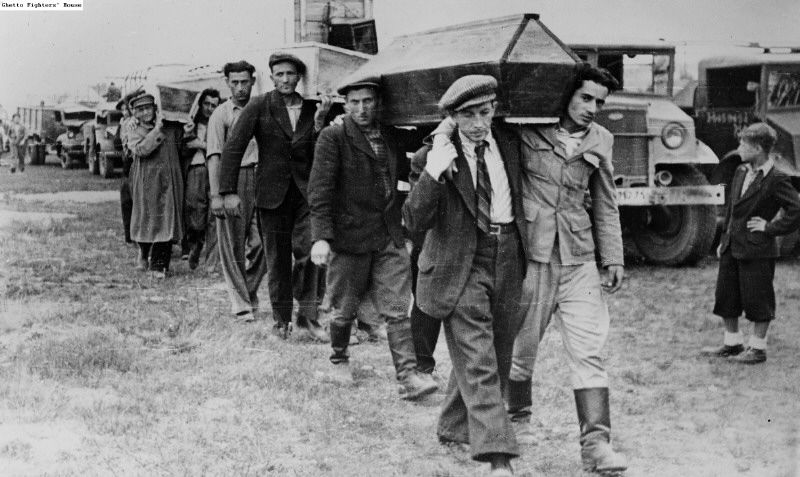
A year after the war, a crowd of Kielce residents, supported by police officers and soldiers, murdered more than forty people, mainly Jewish survivors of the Holocaust. The crime exposed the persistence of post-war antisemitism and accelerated Jewish emigration from Poland.

March 1968
The state-led antisemitic campaign
The communist authorities used student protests to unleash a campaign against citizens of Jewish origin. Around 13,000 people were forced to emigrate, almost destroying the Jewish life that had begun to revive in post-war Poland.

1987
Publication of Jan Błoński’s essay The Poor Poles Look at the Ghetto
Jan Błoński called on Poles to reflect on their indifference to the Holocaust and their moral co-responsibility for the fate of their Jewish neighbours. The debate prompted by the essay prepared the ground for the later dispute over Jedwabne.
(ARTIST)
JAN KLATA
Jan Klata is among the artists who, after 1989, have consistently put Polish narratives of history to the test. In his theatre, memory is neither a storehouse of facts nor a source of ready answers, but a field of conflict between individual experience and national myth. The director asks what the official narrative conceals and whom it deprives of the right to their own version of the past.
He combines documents with classical texts, music, irony, and striking stage imagery. From these heterogeneous materials he builds productions that do not reconstruct history, but examine who gives it meaning and how.
In Transfer!, Klata juxtaposed testimonies of Poles and Germans displaced after the Second World War with the decisions of politicians shaping Europe’s new order. In H., performed in the Gdańsk Shipyard, he treated a site associated with Solidarity not as a monument, but as a space of dispute over the legacy of political change.
Utwór o Matce i Ojczyźnie (A Piece on Mother and the Fatherland) showed how the memory of the Holocaust and the Polish-Jewish past permeates family conflict, language, and the body. Klata’s theatre undermines the certainty of official narratives, revealing the difference between the history of the victors and the experience of those who bear its costs.

Jan Klata; Adrian Grycuk; Adrian Grycuk, CC BY-SA 3.0 PL; 2018.
Jan Klata wrote his first play when he was only twelve years old.
He led the National Stary Theatre in Kraków and has served as director of the National Theatre in Warsaw since September 2025.
He was the second Polish artist, after Krzysztof Warlikowski, to receive the Europe Theatre Prize in the New Theatrical Realities category.
(KEY CONCEPT)
Critical reconstruction
Critical reconstruction challenges the belief that the past can be faithfully recreated. It returns to earlier events while showing how their image is produced from incomplete sources and artists’ decisions. In theatre, it may repeat historical actions or confront documents with the living presence of performers.
In Poland after 1989, it helped examine disputes over history and the consequences of the political transformation. It cannot guarantee truth, because the selection of material and the mode of staging create a new interpretation. Its strength lies in revealing those choices and the gaps in the archive. The central question is therefore not whether a repetition is faithful, but what it allows us to see in the past and why we are returning to it now.
Questions to consider
How does the choice of actor, space or sequence affect the story?
Questions to consider
How can theatre reveal its own decisions instead of concealing them beneath the appearance of historical truth?
Questions to consider
Why do particular events from the past return to the stage at a given moment?
(Key event)
2004–2015
The Digital Theatre Archive
_Nick_Fancher_Photos_ID6169_edited.jpg)
At the beginning of the twenty-first century, traces of a performance still had to be sought in scattered sources. Since 2004, e-teatr.pl has documented current theatre life by collecting news of premieres and critical texts. This gave theatres outside the largest centres lasting visibility. Launched in 2015, the Encyklopedia Teatru Polskiego (Encyclopaedia of Polish Theatre) connected people, productions, and institutions in a historical network.
Neither service preserves a live performance, but both make it possible to ask new questions about its meaning. Digital memory also has gaps because it depends on surviving sources, the way they are described, and editorial decisions. An archive not only preserves theatre history; it also helps determine what will remain visible.

September 2006
Launch of the Polona digital library
The National Library began providing free online access to books, periodicals, photographs, posters, and ephemera. The collection includes sources for studying the history of Polish theatre without physical access to archives.

1 April 2009
Establishment of the National Audiovisual Institute
The institution was established to digitise and make available Poland’s audiovisual heritage, including theatre. Ninateka, the platform it developed, enriched the digital memory of the stage with recordings of performances.

12 March 2020
Suspension of cultural institutions’ activities
After auditoriums closed, theatres streamed performances and made archival recordings available. The pandemic showed that a digital archive could serve not only as a repository of traces, but also as a temporary repertoire.
(PERFORMANCE)
2006
Transfer!

Transfer! gives the stage to Polish and German witnesses of the forced post-war displacements, who recount their own experiences of losing their homes, enduring violence, and beginning life again. Klata confronts their personal testimonies with grotesque scenes from the Yalta Conference, where Stalin, Churchill, and Roosevelt determine Europe’s new borders. History on the grand scale is shown from the perspective of people treated by politicians as pieces on a map.
“Nine elderly Germans and Poles recount [...] onstage their traumatic experiences as young people during the war and the mass displacements that followed. [...] In the finale, each elderly person sits alone on a chair in turn, while a photograph of them as a child appears on the screen. By organising a shared memory session for displaced Poles and Germans, Klata drew on group psychotherapy methods based on the belief that the sense of simultaneously confronting a similar trauma or guilt helps individual members of the group overcome it.”
— Rafał Węgrzyniak, Seans pamięci wypędzonych, “Odra” 2007, no. 1. (SOURCE)
“I’m eighty-four—why should I be wandering around the world? But when they ask and plead, how can I back out now? I have to go,” sighs Karolina Kozak from Pielaszkowice near Środa Śląska. She goes on to complain that another trip to France is coming up, even though Christmas is approaching and there is more work than ever at home. A moment later, however, she takes out a photo album. Since its premiere in November 2006, Transfer!, in which Ms Kozak appears, has already been performed seventy times—in Berlin, Moscow, Bydgoszcz, Łódź, Nitra in Slovakia, Gliwice, Olsztyn, Szczecin, Brussels, Paris, Lille, Lyon, and Wrocław.”
— Tomasz Wysocki, Aktorzy historii, “Gazeta Wyborcza – Wrocław” 2010, no. 4, 6 January. (SOURCE)
CHAPTER 03
PRIVATE MEMORY
2009
Family secrets, political mourning, intergenerational conflict and class shame reveal that memory is often lived before it can be explained.
(ARTIST)
Monika Strzępka and Paweł Demirski
A naked Polish prime minister negotiates the country’s future with Stalin. The more firmly he speaks, the more clearly his powerlessness becomes visible. This image from Niech żyje wojna!!! (Long Live the War!!!) captures the method of Monika Strzępka and Paweł Demirski. History returns in their work not as a museum reconstruction, but as a mixture of a poorly remembered television series, political ritual, and family shame. Strzępka translates the fractures in Demirski’s texts into loud ensemble spectacles full of songs, farce, and abrupt shifts of tone. Familiar narratives lose their self-evidence, while actors rebel against the roles imposed on them.
In Dziady. Ekshumacja (Forefathers’ Eve: Exhumation), the duo dismantled the Romantic myth of Polishness founded on suffering and a belief in the nation’s moral exceptionalism. Niech żyje wojna!!! examined how television, school, and family stories perpetuate a ready-made image of war, while W imię Jakuba S. (In the Name of Jakub S.) linked the memory of peasant revolt with contemporary shame about social origins and the inequalities of the middle class. Strzępka and Demirski showed that the past operates through everyday gestures, language, and social divisions. Their theatre asks who creates the dominant narrative, whose interests it serves, and whom it leaves outside the frame.
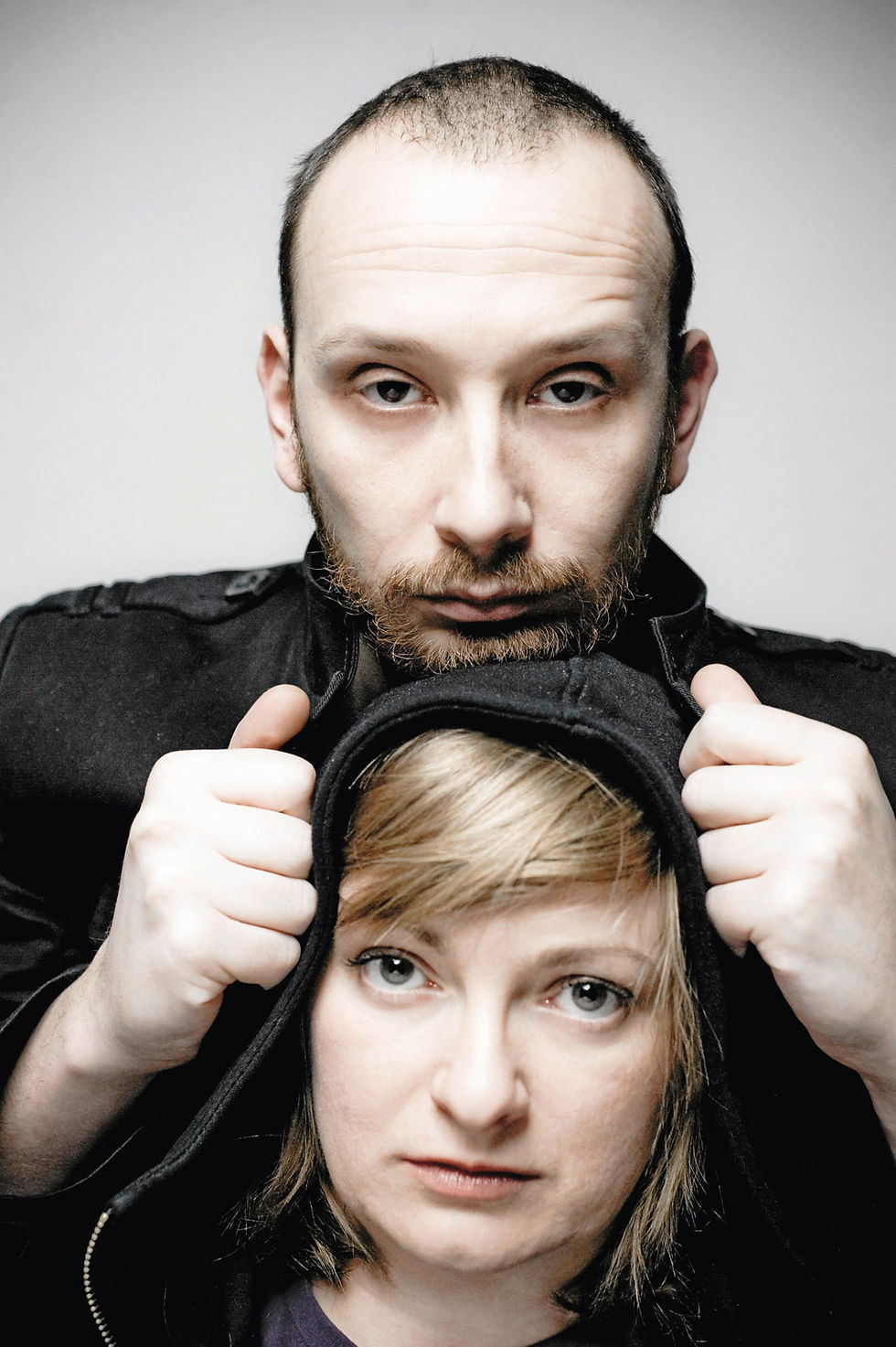
The duo’s most important early productions were created in post-industrial Wałbrzych, far from Poland’s largest theatre centres.
Around Tęczowa Trybuna 2012 (Rainbow Stand 2012), the artists initiated an online campaign for dedicated LGBT+ sections at the European football championship.
In 2016, they created the eight-episode Artyści (The Artists), the first television series devoted to the inner workings of Polish theatre life.
(PERFORMANCE)
2009
Między nami dobrze jest

Między nami dobrze jest (No Matter How Hard We Tried) is a grotesque portrait of three generations of women who live together yet cannot create a shared narrative of the past or of their own identity. The production confronts the memory of war with the language of consumerist modernity, exposing the breakdown of interpersonal and intergenerational bonds.
“A pompous rhythm mixed with the sound of an aeroplane and a rock guitar, the past with the present. On the screen-walls, a one-room flat occupied by a three-generation family of women was visualised in hand-drawn lines—a phantasm of reality, though full of everyday details. The confrontation between the oldest generation, which was ready to die for the homeland, and the youngest, which could barely grasp such a goal, took place over the head of the mother’s generation: a lost generation, ground down by the Polish People’s Republic and the reality after 1989. The simplest word meant something different to each of them.”
— Maryla Zielińska, “25xXXI. Spektakle ćwierćwiecza: Między nami dobrze jest,” “Teatr” 2025, no. 12. (SOURCE)
“The TR Warszawa production also takes stock of twenty years of a free Poland. The lies of communism, the shoddy goods and shortages of the Polish People’s Republic, have been replaced by predatory turbo-capitalism. Instead of prosperity, it offers virtual life and dreams bought on credit: absurd promotions, manufactured celebrities in hopeless talk shows and television series.”
— Jacek Cieślak, “Teatralna bomba prosto z Polski,” “Rzeczpospolita,” 28.03.2009. (SOURCE)
(KEY CONCEPT)
Postmemory
Can we remember something that happened before we were born? Postmemory describes a relationship to the experiences of earlier generations that we encounter through family stories, photographs, or silence, yet experience almost as if they were our own. Marianne Hirsch developed the concept in writing about the children of Holocaust survivors.
In theatre, postmemory gives a body and voice to traces of the past. Performers do not try to recreate another person’s experience; they show how it affects those who are alive. The stage does not recover what has passed, but reveals the route by which fears, images, and silences travel between generations. The past becomes intimate without ever becoming a personal memory.
Questions to consider
How can family silence transmit the past as powerfully as a story that is told?
Questions to consider
How can another person’s experience be shown onstage without presenting it as one’s own?
Questions to consider
When does the story of someone outside our family begin to feel close to us, and why?
(Key event)
2010
The Smolensk Air Disaster

Fragments of the Polish presidential Tu-154 at the crash site in Smolensk; Vitebsk Popular News; Serge Serebro; Serge Serebro, CC BY-SA 3.0; 2010.
On 10 April 2010, 96 people, including President Lech Kaczyński and Maria Kaczyńska, died in an air crash near Smolensk. The delegation was travelling to commemorate the victims of the Katyn massacre. The tragedy therefore became intertwined with the memory of a crime concealed by the Soviet authorities for decades. Shared mourning quickly gave way to disputes over the burial, the causes of the crash, and public rituals of remembrance.
Monthly commemorations became a marker of political allegiance. Theatre showed the collapse of a common narrative. 10.04 juxtaposed Polish and Russian perspectives, while Spisek smoleński (The Smolensk Conspiracy) turned conflicting theories into grotesque. Smolensk became a question of whether community is still possible when memory serves political division.

13 April 1990
The Soviet Union admits responsibility for the Katyn massacre
After half a century of denial, the Soviet authorities confirmed that Polish prisoners of war had been murdered by the NKVD. The disclosure of the truth helps explain why the 2010 disaster was quickly inscribed into a history of Polish-Russian mistrust.

2016–2018
Exhumations of the disaster’s victims
Prosecutors re-examined the remains of most victims, uncovering errors in Russian documentation and cases in which bodies had been switched. This deepened the dispute over the earlier investigation and forced families to relive their grief.

10 April 2018
Unveiling of the Smolensk monument
The monument was erected in Piłsudski Square, a major site of state ceremonies in Warsaw. The disaster was permanently inscribed into the capital’s symbolic space, although the location of the memorial provoked political conflict.
(PERFORMANCE)
2010
Mała narracja

Mała narracja (Small Narrative) is an autobiographical lecture-performance in which Wojtek Ziemilski confronts the revelation that his grandfather, Wojciech Dzieduszycki, had collaborated with the communist Security Service. Combining family memories, archival materials, and video projections, the artist shows how a public accusation shatters the private image of a loved one. The production delivers no verdict; instead, it asks who has the right to confine someone’s biography to a single version and whether responsibility for choices one did not make can be inherited.
“The twists and turns of historical policy directed Poles’ attention towards the guilt—and merits—not only of their fathers but also of their grandfathers. The young playwright Wojtek Ziemilski wrote and directed the play Mała narracja, and performed in it himself at Warsaw’s Studio Theatre. The work was prompted by the fact that Wojtek’s grandfather, Count Wojciech Dzieduszycki, collaborated with the Security Service. The family has yet to recover from this revelation, and the count’s grandson has assumed the burden of investigating the truth and defending his grandfather’s good name.”
— Editors of “Przegląd,” Misja dla wnuczka, “Przegląd” 2010, no. 48, 5.12.2010. (SOURCE)
“Mała narracja is not a public defence of the grandfather by his grandson—ultimately, in the face of complete uncertainty, the defence counsel’s replies are as devoid of truth as the prosecutor’s accusations; one could also repeat after Alice: ‘You’re nothing but a pack of cards!’ Nor is it a process of therapy [...]. Rather, it is a radical attempt to break with the comfortable, highly pleasurable, and ultimately disastrous certainty that things are one way and not another. Mała narracja is therefore not a philosophical exercise in doubt; it is a performative testing ground that, contrary to convention, sees uncertainty and the painful splitting of identity as an opportunity to complete the work of mourning and achieve purification.”
— Paweł Soszyński, “Mała narracja” Ziemilskiego, “Dwutygodnik.com” 2011, no. 56, 20.05.2011. (SOURCE)
(KEY CONCEPT)
Embodied memory
The body reacts to the past before we can name it: a trembling voice, tense muscles, or a fear of touch may endure longer than the story we tell about ourselves. Embodied memory therefore allows us to see the body as an archive of traces rather than facts. In theatre it becomes especially visible because the past returns not only in words, but also in movement, voice, or a refusal to act.
The concept helps us speak about violence, illness, or grief that cannot be arranged into a coherent narrative. The body may reveal these experiences, but it may also conceal and transform them. Such memory resembles a scar: it does not tell the whole story, yet it prevents that story from disappearing.
Questions to consider
Which of your gestures or habits do you recognise as inherited from your parents or other people close to you?
Questions to consider
What can a trembling voice or bodily tension reveal that spoken words do not communicate?
Questions to consider
How does the meaning of a scene change when an actor’s body contradicts what the character is saying?
CHAPTER 04
THE LIVING ARCHIVE
2010 — NOW
Artists begin to treat theatre history as a collection of practices rather than a fixed canon. Documents, bodies and classical texts become materials that can be borrowed, challenged and activated again.
(Key event)
2010—2013
RE//MIX
_edited.jpg)
Teatr Komuna Warszawa, ul. Emilii Plater 31; Komuna Warszawa; Adrian Grycuk; Adrian Grycuk, CC BY-SA 3.0 PL; 2021.
Between 2010 and 2013, Komuna//Warszawa produced four seasons of the RE//MIX project. More than forty artists returned to the works and methods of their predecessors, guided by fascination, disagreement, or personal history. Remix did not mean a collage of quotations or an obligatory tribute. It tested what an earlier practice might mean in another time and a new performance.
Short lectures introduced audiences to the originals and allowed them to follow their transformations. The series functioned as a living archive in which art history survived not as a static document, but as a practice adopted, altered, and sometimes misread. RE//MIX asked whether a work lives longer in an archive or in the bodies of the next generation.
.jpg)
2009
The Grotowski Year
The tenth anniversary of Jerzy Grotowski’s death and the fiftieth anniversary of the Theatre of 13 Rows were marked by performances, exhibitions, conferences, and publications. The programme showed that his legacy can be transmitted through documentation and through the practice of successive artists.

1 October 2010
Establishment of the Institute of Music and Dance
The new state institution began supporting, researching, and documenting Polish contemporary dance, which had previously lacked its own institutional base. It drew attention to art preserved in recordings and descriptions, but also in bodies, working methods, and the memory of an artistic community.

12 September 2014
Opening of Cricoteka’s new building
The Tadeusz Kantor Centre for the Documentation of Art in Kraków combined an archive, museum, gallery, and performance space. Juxtaposing the permanent exhibition with contemporary art turned Kantor’s legacy into material for new interpretations rather than a closed chapter of history.
(PERFORMANCE)
2011
W imię Jakuba S.

W imię Jakuba S. (In the Name of Jakub S.) invokes Jakub Szela, leader of a nineteenth-century peasant uprising in Galicia, to address the repressed peasant roots of the Polish middle class and the persistence of social inequality. In a grotesque montage of history and the present, serfdom is confronted with the reality of mortgages and corporations. The production asks why the memory of peasant suffering and violence is so difficult to incorporate into the Polish story of the past.
“Jakub Szela is surrounded, on the one hand, by a forgotten and largely popular legend of the leader of a peasant uprising against the system of serfdom and, on the other, has been branded a national traitor whose bloody revolt helped thwart yet another noble-led struggle for independence. Contrary to a simplified historical interpretation, he appears here as an essentially ambiguous figure. Yet the production is less concerned with the historical person than with the myth behind him—a myth that has yet to be created, or perhaps rather extracted from the historical unconscious.”
— Ewelina Godlewska-Byliniak, “W imię Jakuba S.” Strzępki i Demirskiego, “Dwutygodnik.com,” December 2011. (SOURCE)
“Everyone should be terrified that it took only two decades for Poles to forget how to rebel—we have become so dependent on the vision of ourselves in a capitalist paradise. We talk mainly about money; we fear that the crisis will cost us our jobs and drive us out of our flats, apartment blocks, and gated communities. Back to the countryside! To a cottage in retirement. Yet not so long ago, all we needed for happiness was to lie in a meadow. To look at the sky. And chew on a blade of grass.”
— Jacek Cieślak, Polskie fatum, “Rzeczpospolita” 2011, no. 288. (SOURCE)
(PERFORMANCE)
2013
Kronos

Kronos is not a straightforward staging of Witold Gombrowicz’s intimate diary, but a production about memory, self-exposure, and the ordering of one’s own life. The actors expand Gombrowicz’s terse notes by incorporating episodes from their own biographies, while cameras, projections, and a fragmentary narrative confront bodily presence with a technologically processed image. The production asks whether public confession brings a person closer to the truth about themselves or becomes yet another form of self-creation.
“It was meant to be one enormous provocation, with the audience as its victim. It began with the notice ‘Performance cancelled.’ Then a group of actors from the Polish Theatre were supposed to imagine themselves as Gombrowiczes and recount their own stories. The production effectively had neither a beginning nor an end. It was interrupted by film sequences and musical performances. Many of the things that appeared were a matter of chance. Those bored by the stories they heard watched intently as a robot wrote individual words on the screen.”
— Jan Bończa-Szabłowski, Kronos czyli czas stracony, “Rzeczpospolita,” 9.04.2014. (SOURCE)
“Garbaczewski’s production is a story of hypocrisy, but also of memory. The set consists of silver cones—neurons. A memory-impulse takes the form of a rabbit; when the characters set off in pursuit, the group becomes caught in a loop and it is no longer clear who is chasing whom. A robot standing on the forestage mechanically fills successive sheets of paper with a single line from David Lynch’s Lost Highway: ‘I like to remember things my own way’—seemingly obvious, but perhaps not to everyone, given the battles over memory and the past that have been unfolding in Poland and Polish theatre for several years.”
— Aneta Kyzioł, Co to, k…, jest?!, “Polityka” 2014, no. 2 (2940), 7.01.2014, p. 67. (SOURCE)

(VOICE)
Radosław Rychcik
Theatre director
“Productions of works by the Polish Romantics form an important part of your oeuvre. What fascinates you most about this literature?
I think the key issue is that this literature is extremely important to the Polish soul. It establishes a paradigm in which, whether we like it or not, we remain trapped. I have also always been interested in the significance of these texts within Polish culture—in what sense they matter, why we stage our cultural performances according to them, and what makes them relevant today. I am interested in expanding our image of these texts: using the method of recycling to discover what a particular historical or political context can introduce into them.”
Magdalena Figzał-Janikowska, Teatr jako sztuka skondensowanego działania, interview with Radosław Rychcik, “Teatralny.pl,” 26.03.2018, (SOURCE)
(PERFORMANCE)
2015
Aktorzy żydowscy

Aktorzy żydowscy (Jewish Actors) gives a voice to six members of the Jewish Theatre ensemble, who ask what it means to represent Jewish culture in Poland, where the Holocaust almost annihilated the Jewish community. The script grows out of the performers’ conversations and biographies, but combines document with fiction, undermining the credibility of the actor’s confession. Smolar shows an institution trapped between the duty of remembrance, audience expectations, and the need to break free from stereotypes of Jewishness.
“Simple in its construction and form, the production moved [...] beyond a discussion of the theatre’s identity and revealed a complex image of a Jewish minority that functions in Polish society more as a phantasm than as a real group. In 2015, dramaturg Michał Buszewicz and director Anna Smolar arrived with questions: What is this place? Who are its actors? For whom do they perform, and why? Who should define the theatre’s Jewish identity, and how? Does the audience’s background matter? Do the actors have Jewish roots? On whose behalf do they speak? Finally, what meanings does the adjective ‘Jewish’ carry? Paradoxically, the production offered no answers, yet the very creation of a space in which such questions could be asked was a political gesture.”
— Marta Bryś, 25xXXI. Spektakle ćwierćwiecza: AKTORZY ŻYDOWSCY, “Teatr” 2025, no. 12. (SOURCE)
“The stories told by the actors in monologues form narratives of failure, both personal and artistic. Things were supposed to turn out differently, but they turned out as they did, so the actors stayed. They do feel that they cannot develop and that they would have gone further elsewhere; that if they did not perform in Yiddish, they would probably have a larger audience. They also know perfectly well that the profession treats them with a degree of condescension.”
— Piotr Morawski, Żydowscy, prowincjonalni, “Dwutygodnik.com” 2015, no. 161, June 2015. (SOURCE)
(INSTITUTION)
SINCE 2018
Teatr na Faktach
Teatr na Faktach (Theatre of Facts) has operated at the Jerzy Grotowski Institute in Wrocław since 2018. As a documentary-theatre laboratory, it has no permanent repertory company; instead, it teaches successive participants how to work with real experience.
Artistically led by Krzysztof Kopka and co-created by Jakub Tabisz, the project combines education with performance-making. Participants construct productions from authentic statements and archival materials. They address events too recent for a public interpretation to have become established, turning the stage into a place where the present is recorded.
Nowi (The Newcomers) gave a voice to Ukrainian residents of Wrocław speaking about migration and the loss of home. Paraliż. Sprawa Igora Stachowiaka (Paralysis: The Igor Stachowiak Case) confronted the parents’ tragedy with the language of police procedure, while Pogranica (Borderland) grew out of experiences of the humanitarian crisis on the Polish-Belarusian border. Teatr na Faktach does not impose a single style; it provides a lasting educational and production base for verbatim, a method founded on the literal use of authentic statements. Here, memory means not only returning to the past, but also accepting responsibility for the way events still in progress are recorded.

Dawny klub wioślarski przy Na Grobli 30/32, Instytut im. Jerzego Grotowskiego, Wrocław; Instytut im. Jerzego Grotowskiego; Barbara Maliszewska; Barbara Maliszewska, CC BY-SA 3.0 PL; 2011.
Real People on Stage
In Nowi, Ukrainian residents of Wrocław were not merely the subjects of interviews—they appeared onstage and told their own stories.
Parents' Voices in the Performance
The parents of the deceased provided the artists with materials for Paraliż. Sprawa Igora Stachowiaka, while actors reproduced their statements.
Voices from the Border
In Pogranica, the story incorporates volunteers’ brief telephone messages about people waiting in the forest and shortages of water, nappies, and power banks.
(VOICE)
Dariusz Kosiński
Theatre scholar and professor at Jagiellonian University
“In my view, a living culture is one that continually talks to its roots and debates its own past. To me, this remains relevant and important, and it ought to be a binding principle. Another issue [...], however, is that the ways of seeing the world represented by older works are unexpectedly interesting to us. All those people of the past—both great artists and less outstanding figures—saw things in ways that we no longer do. We live in a transformed world, think through different patterns, and our models of perceiving reality have been radically rebuilt. Paradoxically, those who used ways of seeing the world that were self-evident in their own time but surprising to us today may have something more interesting to tell us than contemporary artists.”
Jakub Kasprzak, “Konserwatyzm polskich scen jest fantazją,” interview with Dariusz Kosiński, “Teatralny.pl,” 14.02.2020, (SOURCE)
(PERFORMANCE)
2022
1989
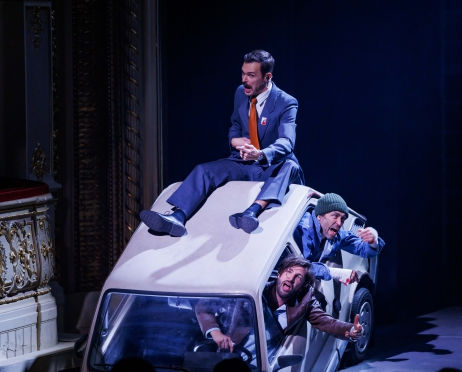
1989 is a musical about the fall of communism in Poland, seen from the perspectives of political leaders as well as their families and loved ones. The production shows how history on the grand scale intertwines with everyday life, while the memory of the 1989 breakthrough remains the subject of disputes, powerful emotions, and constant reinterpretation.
“Every scene and every song in 1989 contributes to a narrative intended to serve as a genealogy of solidarity, community, and rebellion in Polish society. In both content and form—rap is the musical’s principal genre for good reason—the production is meant to build a bridge between past and present, drawing from both time frames what is positive and motivates people to come together. It is more about alliances than conflicts, action than dying in battle, and everyday life than watershed events. Crucially, it is more concerned with the workers’ cause and perspective than with intellectual deliberation.”
— Maja Głowacka, Inteligencko-komunistyczny spisek czy robotniczy strajk? Sukces czy klęska? [on the musical “1989”], “Krytyka Polityczna,” 3.06.2023. (SOURCE)
“Focusing exclusively on a positive myth resembles the ceaseless writing of a heroic Polish history: a Disney fairy tale in which ‘everyone lived happily ever after,’ although no one is interested in precisely how they lived. The creators of 1989 were inspired by Lin-Manuel Miranda’s American musical Hamilton, about the life of one of the Founding Fathers of the United States. But the musical, created seven years ago, is separated from the events it describes by more than two centuries. 1989 was created barely three decades after the transformation—and we continue to feel the effects of what happened then.”
— Jakub Knera, Pułapka pozytywnego mitu, “Dwutygodnik.com” 2023, no. 351. (SOURCE)
(VOICE)
Andrzej Błażewicz
Dramaturg and director
“I agree with the statement that one of theatre’s purposes is to work through what has been repressed, forgotten, deferred, or filed away. Such explorations concern the fundamental question of where we come from and therefore who we are. From a scientific perspective, it is no secret today that traumas are inherited: they are passed down to us by our parents and grandparents. In my work, I often explore the family as an organism that has been ‘through experience.’ Understanding what our ancestors lived through—above all, the experience of the twentieth century—is important and compelling for theatre.”
Zuzanna Liszewska-Soloch, Śladami ludzkiej pamięci. Rozmowa z Andrzejem Błażewiczem, dramaturgiem i reżyserem, o publikacji jego zbioru “Dramaty historyczne. Ruscy. Pamiętnik zbiorowy i Stan wojenny. Początek/Próby rekonstrukcji,” “Teatrologia.info,” 13.12.2021, updated: 26.10.2023, (SOURCE)