
Language
Welcome to Language
Following Poland’s democratic transition, theatre, freed from state censorship, could finally speak openly. Yet it did not immediately find a language for the new reality. The debate was no longer only about what could be said, but also how to say it and who could be heard.
The stage began to dismantle old forms and seek new ways to communicate. Everyday speech blended with media clichés, text became instruction or testimony, and theatre spoke in chorus, through silence and in Polish Sign Language.
CHAPTER 01
FINDING A NEW LANGUAGE
1990 – 2000
The democratic transformation gave theatre unprecedented freedom, but it also removed the political system against which many artists had previously defined themselves. The question changed from “What are we allowed to say?” to “How do we speak about this new reality?”
(Key event)
1990
The Abolition of Censorship
.jpg)
Censored version of The Birth of Venus; Musée d’Orsay, Paris; William-Adolphe Bouguereau (original painting); Public Domain; 1879.
For decades, Polish theatre had an invisible co-author. A censor could interfere with a text or stop a premiere, so the stage responded through allusion and implication. In 1990, the Main Office for the Control of Publications and Performances was abolished, ending state inspection of productions before they were shown.
Theatre could now speak openly about silenced history, but it lost its special position as a space that had stood in for free media. The closure of the office did not, however, end pressure on artists. Later disputes surrounding Golgota Picnic and Klątwa showed that pressure could come from more than the state. Control no longer had a single centre, but the struggle for theatrical freedom continued.

13 January–29 November 1982
Actors’ boycott of radio and television
After martial law was imposed, actors refused to appear in state media. They continued to perform in theatres, churches, and private flats, strengthening the stage’s role as a space of independent communication and resistance.

2 April 1997
Adoption of the Constitution of the Republic of Poland
The Constitution prohibited preventive censorship and guaranteed freedom of expression and artistic creation. It provided a legal basis for cultural autonomy, although it did not eliminate conflicts between art and other protected values.

11 March 2010
Dorota Nieznalska’s final acquittal
The artist was charged with offending religious feelings over her installation Pasja, which combined a cross with a photograph of male genitalia. After eight years, the court acquitted her, finding that the media had distorted the work’s meaning. The case showed how law and images removed from context could take the place of official censorship.

(VOICE)
Barbara Świąder-Puchowska
Theatre scholar and critic
“The problem in the reborn Poland was no longer [...] an official authority that stigmatised people, but what had survived in the collective mentality. The fact that expressing one’s views no longer carried legal sanctions did not mean that artists knew how to speak or had society’s permission to do so. A language had to be created from scratch for discussing corporeality, pathology, violence, and matters carefully concealed and regarded as shameful. This process may be called the awakening of an awareness that different minority groups have distinct interests—a process that began in the West as early as the second half of the twentieth century.”
Barbara Świąder-Puchowska, Prywatyzacja emocji. Teatr polski po roku 1989, “Dialog” 2019, no. 6 (751), (SOURCE)
(ARTIST)
Krystian Lupa
Krystian Lupa began shaping his theatrical language before 1989, but in the following decade he became one of the main points of reference for the Polish stage.
In Kalkwerk and Wymazywanie, he showed that prose need not be reduced to dialogue and action. Narrative, interior monologue, and music formed parallel layers of the performance. The most recognisable feature of his theatre became its different experience of time. A pause did not interrupt the action, but revealed a thought or an unspoken desire, while a production lasting many hours allowed the audience to observe a character’s slow maturation, disintegration, and withdrawal.
Lupa transferred the same logic to his work with actors. His long rehearsals were based on conversation and improvisation, allowing performers to approach their roles gradually. In Factory 2, the creative process itself became the material of the production, while a camera recorded improvisations and blurred the boundary between character and the actor’s private self.
Lupa changed not only the aesthetics of the Polish stage, but also the understanding of directing, adaptation, and ensemble work. He showed later generations that a text is not a closed set of instructions and that a performance can be a long, risky process of discovering another person.

Lupa translated, adapted, directed, and designed the six-hour Wymazywanie himself—four years before the novel appeared in book form in Polish.
Rehearsals for Factory 2 lasted fourteen months and produced several hundred hours of recordings. This material became a seven-hour performance for which no completed script had originally existed.
Wycinka, based on a novel temporarily banned in Austria after a lawsuit brought by someone who recognised himself in one of its characters, ran for nearly five hours and became a hit at the Avignon Festival.
(ARTIST)
Anna Augustynowicz
Anna Augustynowicz was among the women directors who opened Polish theatre in the 1990s to new drama and new ways of staging it. Under her leadership, the Współczesny Theatre in Szczecin became an important meeting place for Polish and European writing. In Młoda śmierć, reportage-based stories, video, and music replaced psychological storytelling with montage and the rhythm of the media on an almost empty stage. This created a theatre in which the text did not reproduce a ready-made world, but organised the audience’s attention and the relationships between performers.
Over time, Augustynowicz increasingly restricted her theatrical means. She replaced scenery with a space of signs and directed attention to voice, pauses, and tensions between performers. The actor did not disappear into a character, but exposed the theatrical convention and treated the text as a score of rhythms and shifting relations of power.
In Gombrowicz’s Ślub, speech did not describe the world, but established roles, hierarchies, and violence. For three decades, Augustynowicz developed this method within a public repertory theatre, showing that experiment can become a lasting form of work with an ensemble and an audience’s imagination rather than a one-off gesture.

The video projections for Młoda śmierć were prepared by an astrologer living in the United States who was a friend of the director.
The radically austere Miarka za miarkę received the Golden Yorick for the best Polish staging of a Shakespeare play that season.
For Ślub, Augustynowicz became the first woman in the forty-one-year history of the Konrad Swinarski Award to receive the distinction, in 2017.
(PERFORMANCE)
1996
Młoda śmierć

Młoda śmierć (Young Death) is a harrowing story about young people growing up in a reality marked by violence, exclusion, and the disintegration of social bonds. Anna Augustynowicz shows how social experiences become inscribed in the body and language, turning them into testimony from a generation deprived of any sense of security.
“In Anna Augustynowicz’s production at the Współczesny Theatre in Szczecin, the stage is empty. The performance area is marked by a white square on the floor and a large screen behind it. Some events are shown as projections; live actors converse with figures on the screen. Theatre attempted to exploit film’s expressive possibilities almost from the beginning of cinema [...], but it rarely produced good artistic results. Here the effect is excellent. Not only because its difference, originality, and expansiveness ‘wins over’ the audience, distracting them from the artificiality and absurdity mentioned above, but also because it leaves no time for reluctance or disgust.”
— Jacek Sieradzki, Młotek do czaszeczki, “Polityka” 1996, no. 12, p. 54. (SOURSE)
“The late journalist Grzegorz Nawrocki shocked Polish theatre with this play. Before him, no one in the mid-1990s had dared to portray, in such a predatory way, a new generation of Poles who had grown up in a free country. [...] He tried to discover what was going on inside the young killers’ minds. The shock experienced by audiences arose from the absence of an answer. Death explained nothing; it was needless, just like the lives, words, and deeds of a lost generation.”
— Łukasz Drewniak, Pięć sztuk, które wstrząsnęły Polską, “Dziennik,” 8.09.2006. (SOURSE)
(ARTIST)
Grzegorz Jarzyna
Grzegorz Jarzyna changed Polish theatre not through a programme or manifesto, but through a new logic of stage action. In Bzik tropikalny, he combined Witkacy’s plays with the rhythm of a music video and the energy of a rock concert. Rapid montage and expressive acting meant that a classic text ceased to be a monument intended for faithful reproduction. It became material that could be cut, juxtaposed, and filtered through the contemporary imagination. This method answered the experience of Poland in the 1990s, shaped by commercial television, advertising, and Western cinema.
Jarzyna adopted the pace of new media to refresh both classics and contemporary drama. In 2007: Macbeth, he combined Shakespeare’s tragedy with images of war and film projections; in Między nami dobrze jest, he subordinated the stage to the rhythm of Dorota Masłowska’s language.
Under his direction, the Rozmaitości Theatre—later TR Warszawa—became a laboratory for new drama and encounters between theatre, film, and music. Jarzyna also changed the way people thought about a public institution. He showed that a repertory theatre could speak the language of its own time, operate beyond a permanent venue, and use mass culture to test the boundaries of the stage.
_(cropped)_edited.png)
He credited Bzik tropikalny to Grzegorz Horst d’Albertis and appeared at the curtain call wearing the mask of a Balinese demon.
After 4.48 Psychosis, the actors did not take a bow—the production consciously rejected applause for a representation of another person’s suffering.
The New York version of Macbeth was staged in a roofless tobacco warehouse by Brooklyn Bridge, and every performance sold out before the run began.
(PERFORMANCE)
1997
Bzik tropikalny

Bzik tropikalny (Tropical Craze) is an energetic, grotesque story of desire, violence, and loss of control, unfolding in a world of disintegrating roles and conventions. The body becomes a source of impulse, tension, and chaos that bursts through language and the established order of reality.
“The production unfolds in the Malabar Hotel and the Golders’ luxurious villa on Malabar Street, in a world of absurd rubber-and-coffee trusts and tropical high finance. Not only the sounds of the tropics and a dancing demon penetrate the colonial interiors from outside; above all, the famous tropical disease known as tropical craze forces its way in. White people from temperate zones reach a place of trial, a world where passions released by opium fumes acquire far greater importance than their norms and rules.”
— Piotr Gruszczyński, Hotel Malabar, “Tygodnik Powszechny” 1997, no. 9, 2 March, p. 13. (SOURCE)
“Bzik tropikalny [...] resembles contemporary film scripts full of major deals, crime, and sex, but treats them with macabre humour and monstrous cynicism. The director approaches scenes from the lives of white colonisers in the tropics as a delicate parody of melodramas or adventure films set in exotic surroundings. [...] The titular tropical craze is a disease consuming Western civilisation, founded on individualism, the suppression of instinct, and rationalism. In the tropics, this culture disintegrates: Europeans, having become aware of their spiritual emptiness and the tedium of existence, seek oblivion in orgiastic sex, ecstatic dance, and narcotic trance.”
— Rafał Węgrzyniak, Witkacy na prochach, “Życie” 1997, no. 17 (21 January), p. 7. (SOURCE)
(INSTITUTION)
TR Warszawa
How can theatre speak about a world changing faster than the forms it has inherited? Since the late 1990s, TR Warszawa—formerly the Rozmaitości Theatre—has been one of the principal sites of transformation on the Polish stage. Productions by Grzegorz Jarzyna and Krzysztof Warlikowski combined classics and new drama with film imagery, music, and intense acting. Bzik tropikalny and 4.48 Psychosis showed that a text need not be illustrated faithfully. It could be cut, combined with other materials, and rewritten with the contemporary audience’s experience in mind. The theatre did not create a single style, but continually sought new ways of addressing the public.
TR Warszawa became a laboratory for dramaturgy, technology, and new relationships with audiences. Its model of an institution open to younger artists and creative risk was crucial. In Ewelina płacze, Anna Karasińska dismantled the division between actor, character, and private person, showing that an experiment could begin with the simplest theatrical situation. The theatre’s hallmark was therefore not a uniform style, but a readiness to find a distinct language for each subject and every new generation. This enabled a public repertory stage to function as a site of continual change rather than the guardian of a form established once and for all.

A Theatre in a Former Bar
Zaryzykuj wszystko was watched by around fifty people in a former bar at Warsaw Central Station, while passers-by peered at the action through glass walls.
Seventeen Years on Stage
The two-hour-and-forty-minute Oczyszczeni, performed without an interval, remained in the repertoire for seventeen years and was named the season’s best foreign-language production by French critics.
Inspired by Real Encounters
Piotr Trojan’s Grind/r was created from records of more than a dozen real encounters arranged through a dating app, while spectators sat around the stage on chairs and mattresses.
CHAPTER 02
TEXT BECOMES MATERIAL
2001 – 2014
Words become rhythm, quotation, advertisement, testimony, instruction and noise.
Artists dismantle the hierarchy between playwright, director, actor and spectator. A dramatic text becomes only one of many materials from which a performance can be constructed.
(KEY CONCEPT)
Postdramatic theatre
Postdramatic theatre does not mean theatre without drama. Hans-Thies Lehmann’s concept describes performances in which the text ceases to govern the stage and becomes one of its materials. It may be divided, repeated, or used like sound, while meaning is also produced through images and the actor’s presence.
In Poland, the term became widespread after Lehmann’s book was translated in the early twenty-first century. Here, a performance does not merely stage a completed work, but creates its own order. Not every fragmentary or multimedia production is postdramatic, however. What matters more is how the stage combines its means and what role it assigns to the audience.
Questions to consider
When does a multiplicity of theatrical means open new modes of reception, and when does it merely make a performance harder to understand?
Questions to consider
How does the spectator’s role change when they must choose which of several simultaneous actions to observe?
Questions to consider
How does the meaning of a sentence change when it is repeated, broken apart, or spoken against the actor’s behaviour?
(ARTIST)
Dorota Masłowska
Does language describe the world, or tell us what to think about it? From the beginning of her career, Dorota Masłowska has examined this tension and changed the way Polish theatre listens to contemporary Polish. Already in Wojna polsko-ruska pod flagą biało-czerwoną, her characters speak in voices borrowed from everyday conversations and the media. They try to express themselves, but it quickly becomes clear that they are using other people’s words. Their statements reveal not only individual experiences, but also the social anxieties, ambitions, and prejudices that language consolidates before anyone has time to recognise them.
Masłowska processes these voices with an extraordinary sense of rhythm. She combines colloquial speech with advertising slogans and media clichés to create a theatrical language full of contrasts. In Dwoje biednych Rumunów mówiących po polsku and Między nami dobrze jest, speech works like music, driving the conflict and exposing social divisions. An actor must not only speak the text, but also grasp its pace and sound. Language becomes one of the principal characters because it reveals more than the people who use it. Masłowska shows that a community is also created by words that are worn out, borrowed, and misunderstood.

Masłowska wrote Wojna polsko-ruska pod flagą biało-czerwoną shortly before completing secondary school; four years later, she became the youngest winner of the Nike Literary Award.
She recorded the album Społeczeństwo jest niemiłe as Mister D. in a home studio set up in a dressing room.
In the film adaptation of Wojna polsko-ruska, Masłowska appeared onscreen as herself—the author creating the characters’ world.
(VOICE)
Paweł Demirski
Playwright
When you write, do you keep the theatre and the potential audience in mind, or does that sometimes escape you?
I keep the theatre in mind because I write scenes from one day to the next. Let me repeat an idea I have tried to articulate several times, although I do not think it has truly registered—and it should, because it matters. There is a continuing dispute about whether we remain faithful to the author, whether a director has the right simply to take the author into strange territory; in short, whether writing follows a director’s model or an author’s model. To me, this distinction is completely false. Theatre belongs above all to the actor: you write for the actor because it is the actor who carries the “text” through the performance every day, the living material that communicates with the audience. If an actor has a good, intelligently written role, it will reach the auditorium.
Agata Dąbek, NIE dzieci w krótkich gaciach, interview with Paweł Demirski, “Teatralny.pl,” 16.05.2014, (SOURCE)
(PERFORMANCE)
2010
Tu mówi Chór...

Tu mówi Chór... (This Is the Chorus Speaking...) gives voice to a female collective that creates a rhythmic account of the roles imposed on women from fragments of cultural and theatrical works, advertisements, and everyday language. Precisely coordinated voices, whispers, and screams transform the ancient chorus into a political force capable of speaking in many voices at once.
The Theatre Institute’s Chór kobiet project demonstrated that there was no language for describing a woman who was not a sex kitten, a witch, or Mother Poland. By inviting twenty-eight women and girls into the chorus—cooks, princesses, scouts, and mothers—director and vocalist Marta Górnicka revived the tradition of collective commentary, accusation, and lament so common in ancient tragedies. Working with participants selected through an open call, she tried to discover what the contemporary woman needed to scream. There was plenty.
— Joanna Derkaczew, Kobiety protestują chórem, “Gazeta Wyborcza,” 18.06.2010. (SOURCE)
“Górnicka’s innovative idea arrived at precisely the right moment. In 2009, Warsaw hosted the first Congress of Women, bringing together more than four thousand participants to discuss women’s contribution to the history of Poland’s twenty years of political transformation. Magdalena Środa—a philosopher and feminist who served as the government plenipotentiary for the equal status of women and men from 2004 to 2005—described the Congress as a moment when Polish women, previously dispersed, decided to do something for one another: ‘Something had to change in the social structure, in people’s mentality, and in their sense of justice.’”
— Agata Skrzypek, 25xXXI. Spektakle ćwierćwiecza: TU MÓWI CHÓR: tylko 6 do 8 godzin, tylko 6 do 8 godzin…, “Teatr” 2025, no. 12. (SOURCE)
(VOICE)
Artur Pałyga
Polish playwright and theatre screenwriter
Your texts balance between the postdramatic and the narrative; some have a solidly constructed story. Do we still need stories?
Yes, absolutely. When I began in amateur theatre more than twenty years ago, we were against the audience; we simply wanted to give them the finger. If they walked out, fine—they did not have to like it. It was a powerful punk energy. Now it is completely different: I want to be with the audience. I believe the spectators and artists need to be together. I feel a duty to build a community rather than tear it apart. This also means finding a shared language, and that requires a story. Creating stories is therefore close to me—although more on the principles of a poem than a plot-driven narrative.
Kamila Paprocka, Ogarnąć świat w jednym błysku, interview with Artur Pałyga, “Teatralny.pl,” 6.10.2014, (SOURCE)
CHAPTER 03
WHO GETS TO SPEAK?
2015 – 2021
Communication becomes a question of power. The stage increasingly asks who controls language, whose testimony is believed and which forms of communication are treated as legitimate.
(ARTIST)
Anna Karasińska
Who owns a role: the author, the actor, or the spectator who recognises their own ideas within it?
Anna Karasińska opens up these usually separate positions. Her productions develop in rehearsal, and their fundamental tool is the instruction: a command, a description of a situation, or an assigned identity. The actor carries out the task while simultaneously exposing its artificiality. In Ewelina płacze, the performers played their own doubles, constructed from other people’s ideas about them. The audience watched fiction being born and a person trying to make it real before their eyes.
Karasińska, who previously worked in film, radically reduced her theatrical means. In Drugi spektakl, she used the language of instructions and the rules governing audience behaviour; in Fantazja, she left it to the spectators to complete characters and events that were barely indicated through words and gestures. She thereby introduced a way of thinking close to conceptual and performance art into the public repertory theatre. Her production becomes a laboratory of attention in which meaning is not closed within the text, but emerges between performers and audience. At the same time, her theatre asks who gives orders, who follows them, and how language changes a person who has been named as someone else.

The idea for Ewelina płacze arose when a young workshop participant was delighted to discover that he was using the same dressing-room toilet as the stars of TR Warszawa.
After a performance of Fantazja in Dublin, around eighty per cent of the audience stayed for an hour-long discussion with the artists.
Łatwe rzeczy, created with two actresses from Olsztyn, unanimously won the Grand Prix at the 2022 Divine Comedy festival.
(PERFORMANCE)
2015
Ewelina płacze
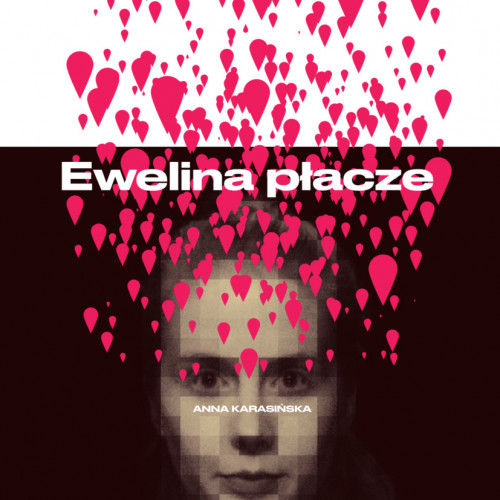
Ewelina płacze (Ewelina Is Crying) is a minimalist comedy about acting, identity, and the images we construct of other people. Celebrated performers from TR Warszawa play amateurs attempting to imitate them, causing roles, biographies, and media personas to overlap. With humour, Karasińska exposes theatrical convention and asks whether it is possible to perform oneself outside other people’s projections.
“The four actors play young people taking part in a casting call organised by TR. Its purpose is to select substitutes for the theatre’s stars. The participants are asked to demonstrate how they would perform each of them. [...] This establishes the production’s basic level: recognisable figures from the theatrical world, distancing themselves from their own identities through the roles of ‘people at the audition,’ judge, comment on, and even parody themselves.”
— Dariusz Kosiński, 25xXXI. Spektakle ćwierćwiecza: EWELINA PŁACZE, “Teatr” 2025, no. 12. (SOURCE)
“When the latest inflated theatrical diagnoses burst like soap bubbles, Karasińska’s ascetic theatre promises nothing. It does not feed on an excess of scenery and costumes, wild projections, or distorted ambient music, nor does it provide simplistic summaries of the most fashionable philosophers. It is theatre made from actors and full stage lighting that reveals every smallest nuance of expression, every suspended voice and glance. [...] Yet beneath the appearance of restraint lies artistic and intellectual abundance.”
— Grzegorz Kondrasiuk, Być sobą, “Do Rzeczy” 2020, no. 43. (SOURCE)
(KEY CONCEPT)
Phonocentrism
Phonocentrism is the belief that the live voice provides direct access to another person’s thoughts and feelings. In theatre, it creates a hierarchy in which speech carries the principal meaning and other modes of communication are pushed into the background. In Polish theatre after 1989, however, digital sound processing increasingly demonstrated that a voice could be detached from a body.
The presence of Polish Sign Language also reminds us that communication need not depend on sound. A critique of phonocentrism does not remove speech from the stage. It asks why the voice is expected to confirm sincerity and why other modes of communication must adapt to the accepted norm.
Questions to consider
What does an audience member lose when captions or sign language are treated solely as technical additions?
Questions to consider
How do a microphone or digital voice processing affect our sense of an actor’s presence?
Questions to consider
Why do we often consider a trembling or breaking voice more sincere than written words?
(PERFORMANCE)
2016
Nie mów nikomu

Nie mów nikomu (Tell No One) gives the stage to Deaf people whose own stories reveal the everyday reality of exclusion from communication. Performed in Polish Sign Language with Polish captions, the production subordinates movement, gesture, and the montage of scenes to the language’s visual grammar. By changing the rules of communication, it deprives the hearing majority of its privileged position and asks who truly has the right to a voice.
“Nie mów nikomu is a successful attempt to familiarise us with the lives of excluded people. (Ziajski argues that Deafblind people experience the most extreme exclusion because their isolation consists precisely in the impossibility of communicating effectively with the rest of society. There is something to that.) Without sentimentality or sensationalising the tragedy of their lives, and with an intelligible, inventive theatrical rendering of their narratives, the production also deprives us ‘normal people’ of our privileged position through a simple ‘loudspeaker-and-headphone manoeuvre.’”
— Juliusz Tyszka, Zza szyby po węgiersku, “Teatralny.pl,” 21.12.2016. (SOURCE)
“Against a simple white background, the most important role is played by the hands of five actors dressed in white—four Deaf and one Deafblind. Covered in coloured powder, they tell the performers’ true stories and thereby reveal their place in the world. These are very simple accounts—of growing up, love, fear, work, and ways of functioning in a verbalised world. They communicate fundamental problems and truths connected with the Deaf community. The production therefore has considerable educational value for an audience unfamiliar with the subject, while also attempting to dismantle certain stereotypes.”
— Anna Rogulska, Samotność motyla, kulturapoznan.pl, 29.11.2016. (SOURCE)
(KEY CONCEPT)
Verbatim
Verbatim begins with listening. Artists record conversations and then construct a script from other people’s statements, preserving how the speakers express themselves. It is not a simple record of reality, but a documentary-theatre technique based on montage. The actor gives another person’s words a theatrical form.
After 1989, the method made it possible to bring the experiences of people seldom heard in public debate onto Polish stages. This does not mean, however, that the stage shows reality without alteration. Questions affect answers, while performance can change their meaning. Verbatim therefore does not settle what truth is. It reminds us instead that quoting another person always entails responsibility.
Questions to consider
How much control should an interviewee retain over the theatrical use of their story?
Questions to consider
How do an actor’s body, voice, and mode of performance shape the reception of words belonging to someone else?
Questions to consider
How would the meaning of your statement change if someone selected only a few sentences and arranged them in a new order?
(Key event)
2017
The Protests Around Klątwa

In 2017, Oliver Frljić directed Klątwa at Warsaw’s Powszechny Theatre, drawing on Stanisław Wyspiański’s play. He transferred the dispute over clerical power to contemporary Poland, and a figure of John Paul II bearing the words “protector of paedophiles” became one of the production’s most recognisable images. The performance provoked protests, police interventions, and a prosecutorial investigation that was later discontinued without charges.
The media uproar obscured Klątwa’s principal subject: sexual violence within the Church and the protection of its perpetrators. The production became one of the most prominent post-1989 disputes over theatrical freedom. It showed how difficult it is to distinguish theatrical fiction from an act when art strikes at an institution that holds real power.
_edited.jpg)
20 June 2014
Cancellation of Golgota Picnic at the Malta Festival Poznań
The festival cancelled performances of Rodrigo García’s production for fear of disturbances announced by Catholic and nationalist groups. In response, public readings of the text took place in numerous cities, transforming a local conflict into a nationwide debate about artistic freedom.

3 October 2016
The Black Protest
Tens of thousands of women protested against an almost complete ban on abortion. The mobilisation showed how disputes over the body, religion, and law move between parliament, the street, and culture.
.png)
11 May 2019
Premiere of the documentary Tylko nie mów nikomu
Released online, Tomasz and Marek Sekielski’s film presented testimony from people sexually abused by priests. Its mass reception broke the silence and drew attention to mechanisms protecting perpetrators—a subject previously obscured by the scandal surrounding Klątwa.
(KEY CONCEPT)
Linguistic violence
Linguistic violence does not always sound brutal. It may hide within an apparently innocent joke that silences another person or denies their right to speak about themselves. Its power therefore lies not in the words alone, but in relations of power and in their effects.
After 1989, Polish theatre increasingly examined this problem by confronting everyday speech with the language of authority. It can thereby expose inequality concealed within ordinary words, but it also risks repeating the harm. Even a statement quoted critically retains part of its force. Freedom of speech does not mean that every voice is heard with equal attention or recognised as equally credible.
Questions to consider
How do the same words operate when spoken by a superior and when spoken by someone without power?
Questions to consider
How can theatre quote a harmful statement without reinforcing the violence it contains?
Questions to consider
Whose voice do you find most readily credible, and whose do you instinctively question?
(VOICE)
Sebastian Majewski
Dramaturg and director
Should theatre be empathetic towards its audiences?
I would once have said no. I have always liked Kantor’s words that no one enters the theatre with impunity. Today, I feel that our reality contains so many unempathetic spaces that it is worth creating one that breaks with them—even if the tasks it sets the spectator are difficult to solve. What matters is that it should not be crude or say: “If you do not understand our language, get out.”
Magda Piekarska, Czekam na ojcobójców, interview with Sebastian Majewski, “Teatralny.pl,” 19.09.2018, (SOURCE)
(ARTIST)
Jakub Skrzywanek
Within a short time, Jakub Skrzywanek moved to the centre of Polish theatre. Beginning with Cynkowi chłopcy, he has created productions that combine document with grotesque and personal testimony with media imagery. He does not comment on reality through text alone. He appropriates its rituals and procedures to test how they shape the collective imagination. He placed stories of the Soviet war in Afghanistan within the convention of a soldiers’ song festival, while in Mein Kampf he confronted the Nazi manifesto with farce and popular culture. He thereby showed that the language of violence can hide within entertainment and apparently innocent habits.
For Skrzywanek, provocation is not an end in itself, but a means of disturbing images regarded as untouchable. Śmierć Jana Pawła II confronted the national myth of the pope with the physiology of dying. Spartakus. Miłość w czasach zarazy, in turn, transformed the theatre into a space for symbolic weddings of same-sex couples. The director does not describe the existing order from a safe distance, but takes over its forms and gives them new meanings. A production consequently becomes not only a story about social conflict, but also an event that changes the relationship between stage and audience and tests the political possibilities of public theatre.

The impulse for creating Cynkowi chłopcy was the burning of an effigy representing a Jew during a far-right demonstration in Wrocław in 2015.
After Śmierć Jana Pawła II, the actors do not take a bow. Instead, spectators may enter the stage and symbolically bid farewell to the pope.
At each performance of Spartakus, a different real same-sex couple gets married. One couple brought two coachloads of guests, and the wedding celebration continued until five in the morning.
(VOICE)
Katarzyna Kalwat
Theatre director
Besides theatre directing, you also studied psychology. How did that affect your theatrical choices?
It gave me the ability to understand complex situations and emotions. [...] I am interested in how language changes reality. Different ways of naming the same thing—different words referring to the same phenomenon—make it into something else. Unfortunately, politics is also about this: naming, interpreting, and changing vectors through words. Political psychology was indeed a very useful, if controversial, background for constructing different narratives in my productions. I play with words, language, and narratives. In my work, I use this knowledge to dismantle language and, above all, expose it as an instrument for concealing, blurring, and dissolving reality. Today, language’s performative value is its destructive power.
Maciej Ulewicz, Katarzyna Kalwat. Maria Klassenberg to też ja, interview with Katarzyna Kalwat, “Legalna Kultura,” 31.05.2019, (SOURCE)
CHAPTER 04
THE LIVING LANGUAGE, CARE AND BELONGING
2022 — NOW
The newest theatrical languages ask not only how we speak, but how we listen. Therapeutic vocabulary enters everyday life. Migration changes who speaks Polish theatre’s stories. Regional and minority languages challenge cultural hierarchies.
(KEY CONCEPT)
Therapeutic language
“I need to set a boundary” can now be heard not only in a therapist’s office, but also in everyday conversation and theatre. Therapeutic language helps people speak about experiences that were previously difficult to express. It is not neutral, however. Concepts such as “trauma” may organise experience, but they can also confine it within a ready-made diagnosis.
Onstage, this language does not serve confession alone. It also makes it possible to examine how the culture of self-knowledge shapes the stories we tell about ourselves. Theatre is not therapy and does not have to heal. Instead, it asks what happens to experience when we describe it using words that promise understanding but sometimes deprive it of complexity.
Questions to consider
How does a conversation change when, instead of describing someone’s behaviour, we call that person “toxic”?
Questions to consider
What do we lose when we reduce a complex experience to a single word such as “trauma” or “defence mechanism”?
Questions to consider
How can we distinguish a theatrical confession created for an audience from a conversation conducted in a therapist’s office?
(PERFORMANCE)
2022
Mój rok relaksu i odpoczynku
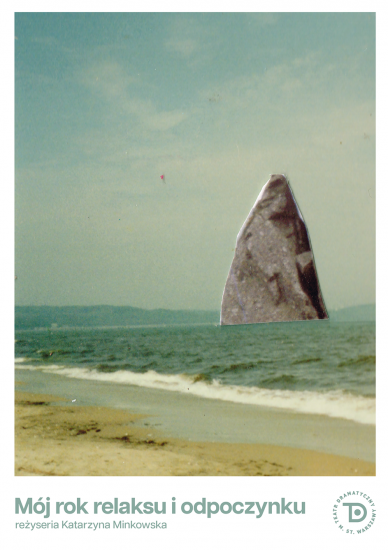
Mój rok relaksu i odpoczynku (My Year of Rest and Relaxation), based on Ottessa Moshfegh’s novel, follows a young woman who attempts to sleep for a year under the influence of medication to cut herself off from unprocessed grief, empty relationships, and a world that measures people by attractiveness. Minkowska frames her experience within an art gallery, where an intimate crisis becomes an installation and pharmacological hibernation becomes both an escape and an attempt at transformation. The production asks whether one can withdraw from reality without turning rest into yet another project of self-improvement.
“This reality, beautiful as if stamped from a mould, whose obverse feeds and propels us, is afflicted with depression underneath. Theatre attempts to capture this condition of society, now diagnosed en masse on psychologists’ and psychiatrists’ couches. [...] We must be terribly tired and depleted if we desire a transformation that will not be another task to perform, that will require no engagement and will amount to ‘rest and relaxation.’ In this sense, the passive project of sleep challenges the ubiquitous cult of attractiveness that we thoughtlessly allow to guide us.”
— Katarzyna Tokarska-Stangret, Odzyskać zdrowy rozsądek, “Teatr” 2023, no. 2. (SOURCE)
“In the briefest terms, it is the story of a young woman immersed in depression, a rather unlikeable misanthrope who decides to sleep for several months. To sleep in the literal sense, using sleeping pills. Towards the end, she wakes only once every three days. If one followed this literally, the production would consist of someone lying onstage asleep—but of course that is not what happens. The narrator tells this story, her life, to someone who films it, while we watch it both onstage and on screens.”
— Kinga Dunin, Terapia dla wszystkich [Mój rok relaksu i odpoczynku at Warsaw’s Dramatyczny Theatre], “Krytyka Polityczna,” 10.12.2022. (SOURCE)
(Key event)
2022
Residencies for Artists from Ukraine and Belarus

In 2022, after Russia launched its full-scale invasion, the Theatre Institute expanded its Artistic Residencies programme—previously established for the Belarusian theatre community—to include Ukrainian artists. Placements at Polish institutions allowed them to continue working and build professional relationships. Within the programme, the Belarusian company Kupałowcy created Gęsi–ludzie–łabędzie, based on prose by Alhierd Bacharewicz.
The most important change, however, concerned who was speaking from the stage. War and repression ceased to be subjects commented on exclusively by Polish artists. The programme opened theatre to other languages and tested whether hospitality could mean listening without imposing a subject or a role.
_1_edited.jpg)
14 August 2020
Announcement of the “Solidarity with Belarus” plan
After protests against Alexander Lukashenko were suppressed, the Polish government offered scholarships, visa facilitation, and access to employment to people facing repression. The plan created a support base for Belarusian students, researchers, and artists arriving in Poland.

2 September 2021
State of emergency on the Polish-Belarusian border
In response to the migration crisis engineered by the Lukashenko regime, Poland introduced a state of emergency in 183 border communities. The entry ban and restrictions on media work revealed the selectivity of Poland’s policy of hospitality.

12 March 2022
Act on assistance to Ukrainian citizens
The Act legalised the residence of people fleeing the war and gave them access to employment, education, and healthcare. It transformed spontaneous assistance into a system of state support that also encompassed initiatives by cultural institutions.
(PERFORMANCE)
2025
Tkocze
![Tkocze [spektakl] fot Przemysław Jendroska-6 (2).jpg](https://static.wixstatic.com/media/eac135_92a9d072121a4013b3e0b86733983430~mv2.jpg/v1/fill/w_980,h_630,al_c,q_85,usm_0.66_1.00_0.01,enc_avif,quality_auto/Tkocze%20%5Bspektakl%5D%20fot%20Przemys%C5%82aw%20Jendroska-6%20(2).jpg)
Tkocze (The Weavers) transfers Gerhart Hauptmann’s drama about the 1844 revolt of Lower Silesian weavers into a world of contemporary inequality, insecure labour, and anger. The workers speak Silesian while the factory owners speak Polish, enabling language to reveal class hierarchy and acquire political force. Kleczewska combines social realism with exaggerated acting, music, and projections, showing how solidarity turns into revolt and revolt into violence.
“Kleczewska’s production has one more, particularly important context. It is being created in Katowice, at a theatre with ‘Silesian’ in its name—here not merely an adjective, but an element of its artistic and civic programme. Gerhart Hauptmann’s play, written by an author with Silesian roots and deeply embedded in Silesia, appears on the programme seventy years after a planned premiere was blocked during rehearsals by the communist authorities in circumstances that remain unclear. Today, too, there are decision-makers who dislike the Silesian language and, more than that, local self-awareness, because both supposedly depart from an allegedly patriotic mould. Once again, theatre thoroughly spoils their mood.”
— Jacek Wakar, Moc truchleje, “Zdania Wakara,” 25.02.2025. (SOURCE)
“We see misery and poverty, but also the excess of operatic form, including in the portrayal of the ruthless, cynical employer [...], who deceives people with his vision of how social roles should be divided. He argues that the market is becoming increasingly predatory and the distribution of wealth ever more problematic. It sounds true, although it may just as easily be a lie serving a fortune that grows at the expense of exploited people. Our world has become so deeply ambiguous that we no longer know how to change it.”
— Jacek Cieślak, Tkocze Kleczewskiej: ludzie pracy chcą rozwalić świat oligarchów, “Rzeczpospolita,” 17.02.2025. (SOURCE)
(VOICE)
Dominika Kozłowska
Deaf theatre and film actress
In Wrocław, you played the leading role in Marta Streker’s production Opowieści z Wielkich Bloków. You portrayed Weronika, an eleven-year-old Deaf girl whose mother—afraid for her daughter—would not allow her to leave home during the summer holidays. How did your family react when you told them you wanted to become an actress?
Weronika loved playing basketball, but she could not do it because her mother worried that the world around her was too dangerous. In trying to protect her daughter, she condemned her to loneliness. When Weronika’s mother was at work, my character escaped from the flat and entered a fairy-tale world of monsters, where she demonstrated her courage. Our stories are similar. My family did not really believe I would succeed in becoming an actress. My hearing brother supported me, however. We are close, trust each other, and I know I can always rely on him. He comes to the premieres of the productions in which I perform and is very proud of me.
Justyna Szczepaniak, PJM to mój język, nie choreografia, interview with Dominika Kozłowska, “Teatr” 2026, no. 5, (SOURCE)