
technology
Welcome to technology
Cameras, the internet, robots, virtual reality and artificial intelligence are no longer merely technical tools in Polish theatre. They have begun to shape performances themselves, transforming bodies on stage, the rhythm of events and the role of the audience.
The internet has carried theatre beyond its walls, and the pandemic accelerated this shift. It widened access, yet revealed that connection is not the same as closeness. The screen allows us to meet across distances, but reshapes the relationship between stage and audience.
CHAPTER 01
THE STAGE MEETS THE SCREEN
1989 – 2006
Technology stops looking like the future and becomes artistic material. After Poland’s political transformation, access to video, computers and eventually the internet widened dramatically.
(Key event)
1989 / 1995
WRO Festival / WRO Media Art Biennale
.jpg)
In 1989, during Poland’s political transformation, the independent Open Studio WRO organised the first Festival of Visual Realisations Around Music in Wrocław. This pioneering Polish media-art event brought together artists working with image, sound, and computers. Technology ceased to resemble a prop from the future and became an artistic material.
Over time, WRO developed into the Media Art Biennale and opened itself to interactive and networked forms. Although it was not a theatre festival, it helped familiarise audiences with practices crucial to the contemporary stage: the camera altering the body’s presence, a device becoming a performer’s partner, and the spectator influencing the course of an event.
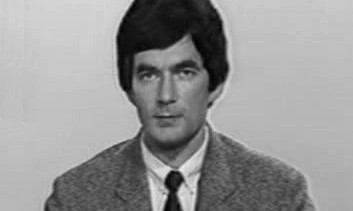
25 October 1952
First public television broadcast in Poland
The half-hour programme was watched on twenty-four television sets in community rooms across Warsaw. It initiated the development of a state-controlled medium that artists would later subject to critical transformation.
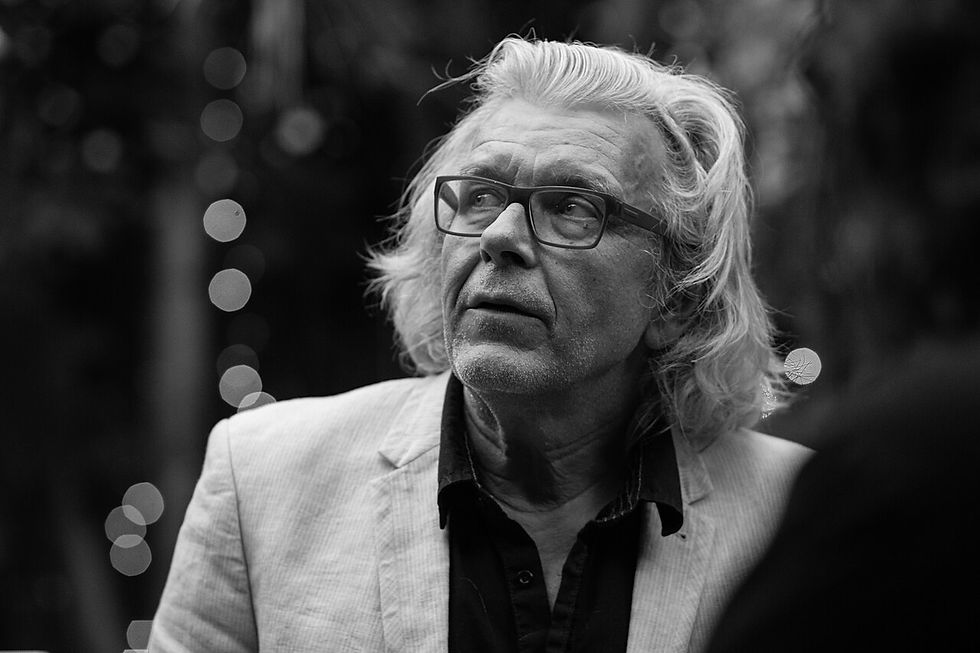
1983
Academy Award for Zbigniew Rybczyński’s Tango
The experimental animation, which superimposed the activities of numerous characters, won an Oscar. Its success demonstrated that Polish experiments with image, montage, and technology could enter international circulation.
.jpg)
17 August 1991
The beginnings of the internet in Poland
The first international data exchange connected the Polish academic community to a European network. The internet opened new possibilities for communication, collaboration, and the distribution of art that WRO would later explore.
(KEY CONCEPT)
Intermediality
Intermediality emerges when theatre not only uses other media but allows them to change how a performance operates. A camera or screen may divide the action between stage and image, juxtapose an event with its recording, or expose the difference between live presence and transmission. An actor’s body may be visible both directly and after digital processing.
In Polish theatre after 1989, such practices developed alongside access to cameras and the internet, although theatre has always combined different means. The sheer number of technologies does not create a new language. Intermediality becomes significant when the encounter between media changes how we see and understand, rather than merely making the stage more attractive.
Questions to consider
How can one tell that technology genuinely co-creates a performance rather than simply embellishing it?
Questions to consider
What happens to the sense of presence when an actor’s image or voice reaches you with a delay?
Questions to consider
What do you look at first when the same actor appears simultaneously onstage and in close-up on a screen?
(Key event)
1991
Poland’s first internet connection
.jpg)
In 1991, an internet connection was established between the University of Warsaw and Copenhagen, an event regarded as the symbolic beginning of the internet in Poland. It was not a single moment but one stage in a process developed by the academic community in a country emerging from communism. Over time, the network moved beyond laboratories and changed access to knowledge and memory, although only what someone had digitised and described became visible.
Theatre later made use of this infrastructure by creating online archives, portals, and broadcasts. The network not only broadened access to performances but also changed the meaning of presence. A production could now exist beyond a theatre building, while its documentation could become part of shared memory.

30 July 1990
Establishment of the .pl domain
IANA assigned Poland its country-code domain, initially used mainly by academic institutions. Poland’s digital identity therefore began to develop even before the country was fully connected to the internet.

August 1993
Launch of the first Polish web server
The server at the University of Warsaw’s Faculty of Physics hosted the first Polish websites, including the Polish Home Page. The internet was ceasing to be solely a channel for communication among researchers and was becoming a space for public publishing.

26 September 2001
Launch of the Polish-language Wikipedia
Internet users jointly created the free encyclopaedia by adding and editing entries themselves. The project expanded access to knowledge, but also exposed problems of credibility, responsibility, and the selection of what deserves to be preserved.
CHAPTER 02
BODIES, MACHINES AND VIRTUAL WORLDS
2007 – 2019
The internet begins influencing performances in real time. Machines determine how performers move. Bodies become digital images and avatars. Artists increasingly explore not only what technology can show, but what happens when humans must adapt to its rules.
(INSTITUTION)
SINCE 2007
neTTheatre
Paweł Passini’s neTTheatre was founded in Srebrna Góra in 2007 as one of the first Polish theatres to investigate live presence on the internet. A transmitter installed on the roof of a former Protestant church made it possible to broadcast performances from a small town to the entire world. In Odpoczywanie (Resting), internet viewers selected images from several cameras and commented on the performance in a chat, while their remarks appeared on screens within the performance space. In Taniec Znaku (Dance of the Sign), materials submitted by viewers became stimuli for the dancer. The network not only expanded the audience but also influenced the course of the event.
After moving to Lublin, neTTheatre developed the idea of the network as a model of collaboration among artists, institutions, and places. During the pandemic, it returned to the problem of remote presence in Dionizos 360. The spherical image allowed viewers to choose their own direction of looking, while actors who had worked on their roles separately met for the first time during the premiere.
neTTheatre’s significance lies in its early recognition that the internet need not be merely a broadcasting channel. It can alter the space and rhythm of a performance, distribute agency between stage and screen, and build a community of people who remain physically distant.

16,000 Viewers Across Four Continents
The first online broadcast of Odpoczywanie was watched by more than 16,000 people on four continents. The two-hour production was transmitted live with stereophonic sound.
12 Hours of Butoh, Live All Night
Taniec Znaku was a twelve-hour butoh improvisation broadcast throughout the night. In 2008, it could be watched both on a computer and through WAP, a service designed for mobile phones of the period.
A Virtual Chorus Without Borders
Dionizos 360 combined three tragedies by Euripides: Fenicjanki (The Phoenician Women), Błagalnice (The Suppliants), and Bachantki (The Bacchae). Its virtual chorus included students, soldiers, and people described as illegal immigrants.

(VOICE)
Bartosz Nalazek
Cinematographer and lighting designer
The common idea of a theatre lighting designer is that they arrive two or three weeks before the premiere, set the lamps, and return to more important pursuits.
The concept is developed much earlier, although the lighting can only be set once the scenery is ready—and that usually happens two or three weeks before the premiere. I always try to talk extensively with the director about particular scenes, sequences, and visual inspirations. The final images emerge only when the production begins to form a coherent whole. What fascinates me about theatre, and Polish theatre in particular, is above all the artistic freedom available to its creators: the freedom to search for new forms of narration and ways of composing a production. This makes original performances possible, while theatre remains a genuinely living art that continually sets itself new directions—something that many people elsewhere in Europe and the world envy us for.
Mateusz Węgrzyn, Projekt spektakl: reżyser światła, interview with Bartosz Nalazek, “Dwutygodnik.com” 2015, no. 165, 28.07.2015. (SOURCE)
(ARTIST)
Iza Szostak
Iza Szostak does not ask how technology can make dance more attractive, but who moves whom: the human moves the machine, or the machine moves the human. Her choreographies construct relationships between the body and an object that ceases to be a passive prop. The object’s weight and construction alter the performer’s movement, while matter becomes an active force co-creating the event. In Balet koparyczny (Excavator Ballet), Szostak translated ideas from Oskar Schlemmer’s Triadic Ballet into the movements of construction machinery. The excavators did not imitate dancers; they created their own scale of gestures, to which the operators had to adapt.
In National Affairs, two performers encountered mobile robots, demonstrating that the movements of both humans and machines depend on programmed rules. In Future Presence, Szostak transferred these questions into virtual reality. The body could become an avatar, be multiplied, or be released from the laws of physics, yet it remained subject to the restrictions of code. Szostak introduced into Polish choreography a dance that emerges between organism and machine. Technology does not remove the body; instead, it reveals it as a shifting arrangement of muscles, devices, and data whose boundaries are also determined by other people’s designs and decisions.

She genuinely learned to operate an excavator. Before creating Balet koparyczny, Iza Szostak and Paweł Sakowicz completed a construction-machinery operating course.
The robots appeared under their own names. The performers’ partners in National Affairs were ZIPPER, Crawler, and Edek, built by students of the Warsaw University of Technology.
The title Skaj is the Limit is an intentional pun. In Polish, skaj means imitation leather, a symbol of the counterfeit luxury of the 1990s. The production approached Poland’s transformation through fakes and objects pretending to embody wealth.
(KEY CONCEPT)
The cyborg body
A cyborg body emerges when technology does more than support a performer: it changes how they experience their own body and act. It is neither a robot nor a futuristic costume, but an arrangement of body and device in which each alters the other’s possibilities. In theatre, such an arrangement may be created by a sensor that turns a performer’s movement into sound.
Technology responds to the body while simultaneously defining the limits of its action. Such an extension does not therefore always provide greater freedom. Assistive technologies should not be presented as a means of repairing a supposedly incomplete person. The cyborg body instead invites questions about who controls the device and who may interrupt the system.
Questions to consider
How can assistive technology be used without presenting a disabled person as someone in need of “repair”?
Questions to consider
What does the body gain—and what does it lose—when the audience primarily sees its digital image or avatar?
Questions to consider
How do a camera or microphone change the way a performer moves, speaks, and perceives their own body?
(INSTITUTION)
SINCE 2016
Cloud Theater
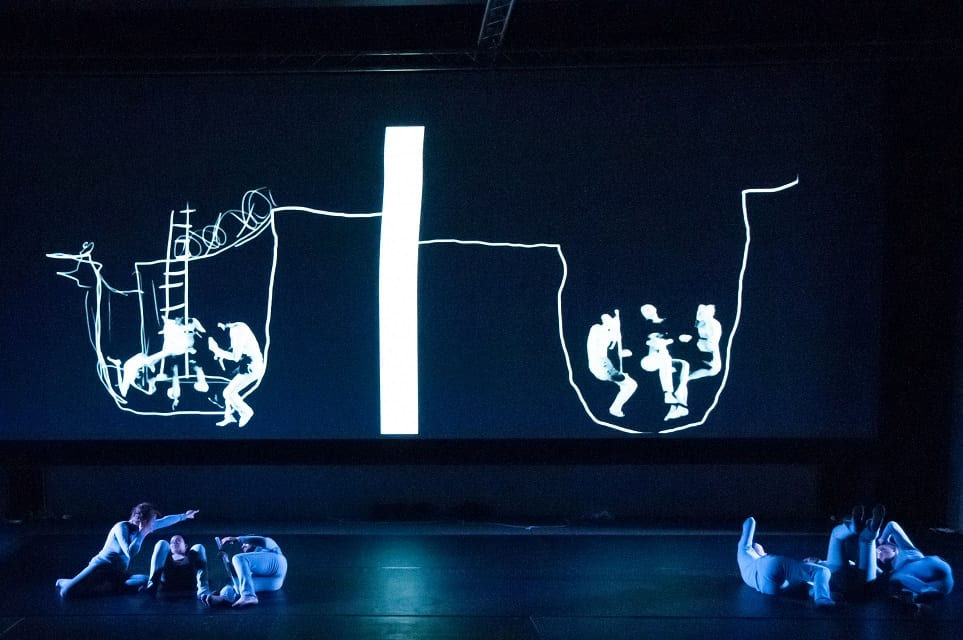
Cloud Theater was founded in Wrocław in 2016 by Teo Dumski. The “cloud” did not mean online theatre, but a shifting arrangement of collaborators, locations, and devices rebuilt for each project. Without a permanent venue or ensemble, the group operated differently from public repertory theatres. Technology did not remain backstage infrastructure; it became a visible material of the performance. The basis of this language was proprietary software that combined drawing with live video and enabled digital scenery to be created before the audience’s eyes.
In “floor acting,” a camera recorded performers lying onstage, while a projection placed their bodies within a space drawn during the performance. The team creating the image and sound also remained visible, so the digital world emerged at the same time as the actor’s gesture and was subject to a similar degree of risk.
Krótki zarys wszystkiego (A Short Outline of Everything) told the history of the world without words, combining the actors’ presence with a cinematic image produced live. Cloud Theater showed that digital media do not have to automate a performance. They can intensify its liveness, dependence on human gesture, and unpredictability.
When a 3D Printer Becomes a Character
The finale of Technologia jest istotą featured “Maryla”—a 3D printer built by Dumski himself and functioning as a character in the performance.
Among the Best of Polish Independent Theatre
Don K. was commissioned by the National Museum in Wrocław, while the monthly magazine “Teatr” named it one of the best Polish independent productions of 2018.
Digital Scenery That Never Looks the Same
Cloud Theater’s technology was also used in the children’s puppet production Ile żab waży księżyc (How Many Frogs Does the Moon Weigh?), whose digital scenery was painted live and looked slightly different each time.
(PERFORMANCE)
2017
Technologia jest istotą

Technologia jest istotą (Technology Is an Entity) is a performance exploring relationships between humans and technology, in which the body becomes a meeting place for biology, algorithms, and digital imaginaries. The production challenges traditional boundaries between the human and the non-human, asking how technologies alter how we feel, remember, and construct identity.
Throughout the production, we remain intellectually active, wondering about the meaning of its symbols and images and the stage actions of the four performers. It is impossible to escape the observation that, although we use technologies, devices, and operating systems, from a cosmic perspective we too are such a technology. This is the most interesting of the thoughts blossoming in the analogue spectator’s mind.
— Grzegorz Chojnowski, Technologia jest istotą (Cloud Theater), blog “Recenzje,” 16.05.2017. (SOURSE)
Technology is an Entity, because every Entity is a Technology. Technology is everything we are capable of experiencing—from the mechanics of the human body to the computing power of contemporary processors.
— Technologia jest Istotą | spektakl, PIK Wrocław, 2019. (SOURSE)
(ARTIST)
Krzysztof Garbaczewski
Does technology separate people, or can it create a new kind of shared experience? This question recurs in the theatre of Krzysztof Garbaczewski, who combines the stage with the visual arts and digital culture.
An actor may appear simultaneously live and on a screen; a camera may take over their point of view; and the spectator may look into spaces invisible from their seat. Literary text meets improvisation, animation, and programming. New media are therefore not decoration, but tools that change how we look and allow us to enter a represented world differently than in traditional theatre.
As the founder of Dream Adoption Society, Garbaczewski develops projects using virtual reality, avatars, and interactive environments. In Nietota, spectators moved between a physical stage and a digital world, becoming participants in the event. Technology serves to investigate identity, perception, and new forms of presence. It also demonstrates that theatre does not have to end where the stage ends. The relationship among actor, spectator, and space can be designed anew each time, while a shared experience may also arise among bodies, screens, and avatars.

Robert Robur also unfolded underneath the theatre. A camera followed actors through the cellars of TR Warszawa, while their point of view appeared on a vast screen resembling an eye.
In Państwo (The State), actors looked on the spectators’ behalf. The performers wore VR headsets, and the image seen through their eyes was transmitted to a screen.
Lady Macbeth was performed inside a shipping container. A small audience watched through its window, while other viewers could follow a 360-degree broadcast on Facebook and YouTube.
(KEY CONCEPT)
Immersion
Immersion occurs when spectators feel that they are not observing the represented world from outside, but are located within it. It is not the same as interactivity. One may make choices without feeling immersed, or remain motionless while strongly experiencing one’s presence inside a created environment. In theatre, immersion is produced above all by the organisation of space, which surrounds the spectator with action and directs their attention.
Digital technologies expand these possibilities but are not necessary. Immersion does not provide complete control either: apparent freedom of movement may lead along a predetermined route. Immersion becomes meaningful when it serves the subject and leaves spectators the possibility of withdrawing.
Questions to consider
What makes you feel inside an event even when you cannot influence its course?
Questions to consider
How much freedom does a performance truly offer if you can move only along a route designed in advance?
Questions to consider
When does intense immersion help us understand a production’s subject, and when does it merely consume our attention?
(PERFORMANCE)
2018
Nietota

Nietota uses Tadeusz Miciński’s modernist novel as a point of departure for a search for contemporary spirituality and a communal ritual. Spectators dance with the actors and then, wearing VR headsets, travel through virtual Tatra Mountains where they encounter the other participants’ avatars. Technology produces an experience that is both private and collective, asking whether community is possible in a digital world.
Despite its flaws, Garbaczewski’s Nietota became another stage in the exploration of new media within theatrical language. Watching this process—and especially participating in it as a spectator—is an extraordinarily absorbing and fascinating experience. This is largely due to the actors, who become guides as well as companions in the psychedelic journey. The spectator–actor relationship in Garbaczewski’s work is neither oppressive nor aggressive: from the outset, the performers try to establish a dialogue with the audience and gain its trust, so that responding to subsequent requests or instructions causes no discomfort. The strength of the sense of community lies in this relationship.
— Aleksandra Sidor, VR, techno lub wspólnotowa separacja, “Teatr dla Wszystkich,” 13.10.2018. (SOURCE)
The VR graphics strongly resemble those of computer games from the 1990s: angular edges, walls of objects merging or dissolving as we move, and frequently visible pixels. None of this is a problem, however, because we immediately allow ourselves to be absorbed by this world as our movements in physical reality are transferred into the virtual one.
— Aleksandra Sidor, VR, techno lub wspólnotowa separacja, “Teatr dla Wszystkich,” 15.10.2018. (SOURCE)
(VOICE)
Krzysztof Garbaczewski
Theatre director
Of course I think about the future of theatre, but I do not mean replacing theatre with virtual reality. My team and I are instead looking for points of contact, or for the kind of extension that occurs when a theatre audience gains access to new visual means such as holograms. Suddenly actors can perform with their own holograms! This gives the imagination a wider field and allows us to rediscover cultural texts that are not themselves new. I feel closer to this approach than to treating these media as an either–or choice.
Jolanta Nabiałek, Hakujemy korporacyjne technologie, żeby tworzyć performans, interview with Krzysztof Garbaczewski, “Krytyka Polityczna,” 2.01.2019, (SOURCE)
CHAPTER 03
THEATRE WITHOUT THE AUDITORIUM
2020 – 2021
The screen becomes a condition of survival.
The pandemic abruptly closed theatre buildings and turned experiments in remote presence into everyday necessity. It also revealed something technology could not reproduce: the simple fact of bodies sharing one space.
(Key event)
2020
The COVID-19 Pandemic
_edited.jpg)
In spring 2020, the pandemic closed theatres, interrupted rehearsals, and deprived artists of income. The stage moved online. At first, recordings were made available; later came live broadcasts and productions created specifically for the screen, such as Oskar Sadowski’s Balladyna, made using a video-conferencing platform. Online theatre reached people who lived far from major centres or were unable to attend in person.
At the same time, it exposed the limits of digital proximity. The image connected performers with audiences but could not replace shared space or bodily presence. After venues reopened, the internet remained an additional entrance to theatre and a record of a period when the institution could survive only outside its own building.

1 June 2017
Establishment of the National Film Archive – Audiovisual Institute
The merger of two state institutions created a centre for digitising films and recordings of theatre productions. Online collections made it possible to treat a recorded performance as more than an archival document.

2013
Launch of Teatroteka
The Documentary and Feature Film Studios began producing screen adaptations of Polish plays that used the language of film rather than simply recording the stage. The project developed a form of theatre intended from the outset to be watched on a screen.
6 April 2020
Launch of the Culture Online programme
The Ministry of Culture introduced grants and scholarships for digital projects. The programme sustained cultural activity while institutions were closed, but made some public support dependent on transferring creative work to the internet.
(VOICE)
Marta Miłoszowska
Theatre director
I checked the number of subscriptions to the National Theatre’s YouTube channel—there are three hundred, while Britain’s National Theatre has more than half a million. This shows the scale of how we think about digital culture and theatre available online. Of course, everyone is trying hard: actors read poems of various kinds and receive a few hundred views. Meanwhile, the National Theatre’s Frankenstein has a million views, and it is a professional production filmed from multiple perspectives using numerous cameras and cranes. In Poland, one can count well-made recordings of theatre productions on one hand, and no wonder, because such a production costs an enormous amount of money and we are not prepared for comparable expenditure. Yet the fact that we do not have such budgets does not mean we can afford to neglect quality.
Magda Piekarska, Teatr musi wyjść z sieci, interview with Marta Miłoszowska, “Teatralny.pl,” 6.05.2020. (SOURCE)
(KEY CONCEPT)
Algorithmic dramaturgy
Algorithmic dramaturgy arises when a set of rules affects the course of a performance. A system may, for example, read a performer’s movement and alter the lighting accordingly. The presence of technology alone is not enough. An algorithm becomes part of the dramaturgy only when it helps determine the order or form of events.
An unpredictable outcome does not mean that a machine creates independently, because it operates within code prepared by people. Authorship is therefore shared between artists and system. The significance of this practice does not depend on how advanced the devices are. More important is whether a production reveals its rules and allows us to ask who may control or change them.
Questions to consider
How does an unpredictable result differ from one that is genuinely independent of its creators?
Questions to consider
What actually creates a performance: the artist’s idea, the programmer’s code, the data, or the performers’ actions?
Questions to consider
How much freedom do spectators have if they can choose only from possibilities previously written into a programme?
(PERFORMANCE)
2020
2020: Burza
.jpeg)
2020: Burza (2020: The Tempest) reads Shakespeare’s drama as a story about the end of anthropocentrism and Prospero’s loss of the right to impose a single version of reality upon the world. Artificial intelligence co-created variable arrangements of scenes, while projections, 3D animation, and camera images overlaid the action with possible courses of events, imitating the unstable workings of memory. Streamed live during the COVID-19 pandemic, the production made technological mediation part of the theatrical encounter at a time of enforced isolation.
A programme using AI (Artificial Intelligence), designed especially for the production, will collect information and opinions in real time from the production team, artists, and viewers watching the premiere stream on TR Online, through their answers to short surveys before the performance. On the basis of this information, the system will make decisions about the arrangement of scene variants and the character of the music and lighting, while continuing to refine its abilities.
— Press information, ed. Marta Korycka, Warszawa. „2020: Burza” – transmisja live premierowego pokazu online, e-teatr.pl, 26.11.2020. (SOURSE)
The director modifies the theory that artificial intelligence will take over the world and says: ‘This will be a real ending. One in which everything collapses, even the digital world—a total fall.’ The island therefore appears to the castaways as a promise, but also as a destructive force that brings about their ruin. There is no hope for them.”
— Alicja Cembrowska, Po tej burzy nie będzie spokoju, “Teatr dla Wszystkich,” 10.12.2020. (SOURSE)
(Key event)
2021
LALKA NOVA

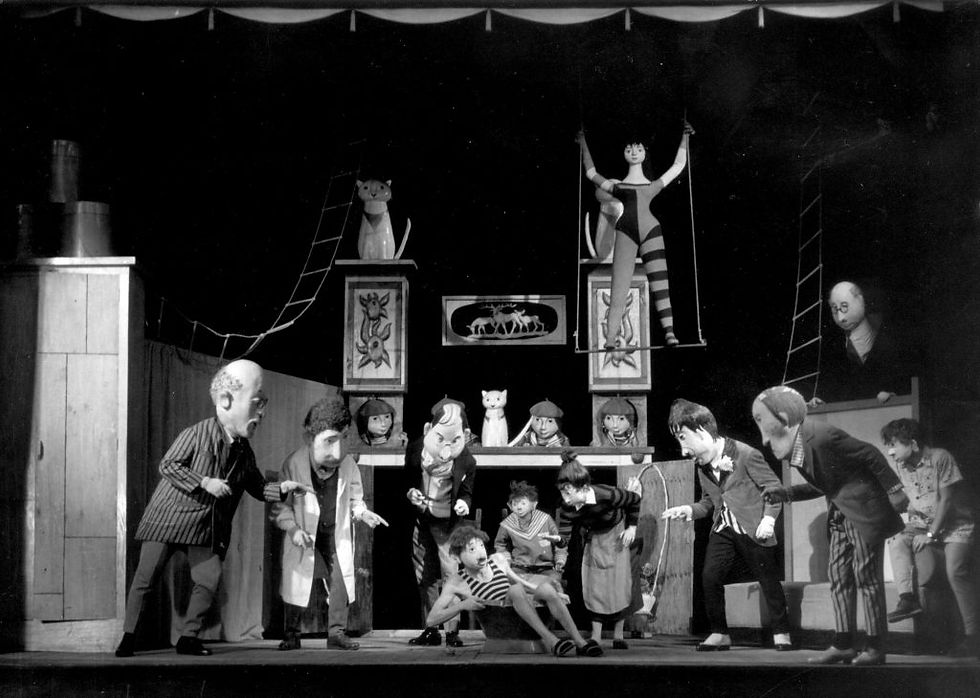
In 2021, the Puppetry Department of the Wrocław branch of the AST National Academy of Theatre Arts hosted the first LALKA NOVA conference, bringing puppetry together with new-media art. Participants asked who animates whom when a human meets a robot, digital image, or algorithm onstage. The presentations and lectures did not announce the end of the traditional puppet, but broadened the meaning of animation.
Technology became not an addition, but a material and partner capable of influencing the performer’s actions. The meeting challenged the simple division between animator and animated object and developed the idea of “digittry,” a fusion of puppetry with digital media. Subsequent editions transformed the conference into a series devoted to new forms of theatre.
1 October 1972
Opening of the Puppetry Department in Wrocław
The independent department began training actor-puppeteers, connecting the school with the Wrocław Puppet Theatre. It created the institutional foundation from which the LALKA NOVA conference would grow half a century later.

27 April 2018
Opening of the Inne tańce exhibition
Warsaw’s Centre for Contemporary Art combined theatre, dance, and performance with interactive installations. The exhibition demonstrated that VR and digital art were entering the Polish performing arts.

12 March 2020
Closure of cultural institutions during the pandemic
Theatres and art schools transferred part of their activity online. Streaming, messaging platforms, and digital environments ceased to be additions and became conditions for creation, teaching, and encounter.
CHAPTER 04
AUTHENTICITY IN THE AGE OF AI
2022–NOW
Images can be fabricated. Bodies can become data. The dead can answer back. The newest technologies intensify an old theatrical problem: what do we believe? Technology becomes not only a medium but a test of authorship, evidence, memory and human agency.
(ARTIST)
Łukasz Twarkowski
Łukasz Twarkowski does not treat technology as an addition to a performance. Image, sound, stage architecture, and performers’ bodies form a single system in which text is only one element. A live broadcast does not so much bring the action closer as produce a second version of it. It organises the gaze, splits time, and blurs the boundary between presence and recording. Spectators know that the production is being created here and now, yet find it increasingly difficult to determine where that “here” is. Twarkowski’s theatre therefore does more than tell stories about a world transformed by media: it organises attention according to their rules.
In ROHTKO, live transmission and recording investigate the difference between original and copy and the value of art in the age of NFTs. The Employees transfers these means into a world of human and humanoid workers, asking about humanity in a world of algorithms. Twarkowski’s language grew from his work as a video artist and his experience with the Identity Problem Group collective, but matured in productions created in Vilnius and Riga. His path exemplifies a transnational model of theatre made through a network of public stages and co-productions. Technology ceases to be a technical effect because it transforms attention, emotion, and the sense of reality.

Respublika lasts six hours and ends in a rave during which the boundary between actors and audience dissolves. One performance did not finish until four in the morning.
The transposed letters in the title ROHTKO evoke counterfeit brand names such as “Adibas.” The production grew from the story of collectors who paid $8.3 million for a forged Rothko painting.
The stage spaceship in The Employees occupies only thirty-six square metres. During short breaks, spectators may change places, walk around, and view it from different sides.
(VOICE)
Łukasz Twarkowski
Theatre director
We are at a moment when, in the digital age, an original and a copy suddenly appear that are completely indistinguishable. An NFT work is no different whatsoever from an infinite number of copies; the only confirmation of its originality is a financial transaction recorded on a blockchain. I find this symptomatic of our times and of the way our psyche is beginning to take shape. We are beginning to live in a world of ever more simulacra. It is interesting that the need for a work to have any material representation in the world is disappearing. Today it may consist solely of a string of zeros and ones, and which one we recognise as the original is merely a matter of social agreement.
Marcelina Obarska, Anka Herbut i Łukasz Twarkowski – Rothko i problem oryginału, interview with Anka Herbut and Łukasz Twarkowski, Culture.pl, 2.03.2022. (SOURCE)
(PERFORMANCE)
2022
ROHTKO
.jpg)
Rohtko begins with the story of a painting attributed to Mark Rothko, sold for millions of dollars and later exposed as a forgery, in order to ask about the difference between original and copy and the sources of an artwork’s value. Twarkowski combines theatre with live film, projections, and electronic music, blurring the boundaries between stage and screen, reality and its mediated image. The deliberately distorted title announces a world in which authenticity becomes a commodity and a copy may elicit genuine emotions.
In the finale of Rohtko, the technical staff come out to receive applause first, followed by the actors and the remaining artists. This reversal is one of several shifts in perspective on art offered by Herbut and Twarkowski. The fact that the scenery is constantly moving seems to suggest a way of watching the production—with curiosity about surprising details and an awareness that there is always something (or someone) onstage beyond the reach of our sight and attention.
— Zuzanna Berendt, Relacje i transakcje, “Dwutygodnik.com” 2022, no. 333, May 2022. (SOURSE)
What, then, are spectators participating in? A performative live event, or a stage experience that would be neither complete nor even possible without advanced technologies, conceptualisations of the latest trends in the (post)humanities or digital art, and even a highly critical engagement with the phenomenon of non-fungible tokens (NFTs)? To put it differently: do audiences experience the interpenetration of different media, or a complication of their statuses?”
— Karolina Felberg, Ikona, “Notatnik Teatralny,” 8.01.2023. (SOURSE)
(PERFORMANCE)
2022
Cyber Elf

Cyber Elf is an autobiographical lecture-performance about the information front of Russia’s full-scale invasion of Ukraine. Magda Szpecht describes her own work as a cyberactivist fighting Russian trolls and disinformation, and uses screens, online materials, and practical instructions to demonstrate how to verify sources and recognise manipulation. The production blurs the boundaries between theatre, journalism, and activism, asking how art can act in wartime.
Almost every performance of Cyber Elf differs from the previous one, because the information Szpecht shares responds to the current situation in the war. Her selection of material also depends on what the director considers interesting in the context in which the work is being shown. As she explained [...], her presence onstage stems partly from the need to keep updating the material—something that would be more difficult if performers not involved in cyberactivism were engaged. Moreover, the content she presents is so brutal and potentially traumatic that she preferred not to expose someone else to it.
— Zuzanna Berendt, Robić użytek z teatru, “Dialog,” 1.04.2025. (SOURCE)
Naturally, it is impossible to remain indifferent to the suffering of Ukrainians and war crimes. Magda Szpecht’s principal aim, however, seems to be education and awareness rather than fear. Understanding the situation beyond our eastern border and the activities that form the everyday work of cyber elves reveals not only the scale of the disinformation in which we live and how easily facts can be manipulated, but also teaches us to verify the information that reaches us.
— Aleksandra Puk, Czego mogą dziś nauczyć nas elfy?, e-teatr.pl, 23.05.2024. (SOURCE)
(PERFORMANCE)
2024
Złote płyty

Złote płyty (Golden Records) begins with the true story of Carl Sagan’s team, which prepared a message about Earth for the Voyager probes to carry to extraterrestrial civilisations. Pakuła transforms the scientists’ deliberations into an absurd musical in which 1970s hits, stylised scenery, and cosmic projections confront the grandeur of the mission with human pettiness, desire, and chaos. The production asks who has the right to create an image of all humanity and what disappears when history becomes a carefully directed act of self-presentation.
The prudish institution that NASA was in the 1970s is confronted here with a group of idealists trying to send a maximally truthful portrait of humanity to a distant galaxy. The scientists and artists are nevertheless forced to navigate censorship directives repeatedly arriving from government headquarters. Nudity is prohibited so as not to offend Earthlings; violence is excluded because alien civilisations might interpret it as a threat of attack. How, then, can one describe humanity and its history—measured by acts of attack and defence—to extraterrestrials while bracketing the human form, the physical dimension of love, war, and robbery?
— Magda Piekarska, Kosmici chcą miłości, “Teatralny.pl,” 14.02.2024. (SOURCE)
The story of the Golden Records suits Pakuła’s interests. It contains uncertainty, American grandiosity, and questions about humanity—all of which make it possible to tell a private story against the background of a grand narrative. Just how grand it is becomes clear in the animation opening the production. The sequence resembles a nature documentary: Earth recedes farther and farther until it remains a tiny point in the vast universe. It is meant to give us a sense of our own smallness, something that will matter later in our reception of the performance.
— Anna Pajęcka, Hello from the Children of Planet Earth, “Dwutygodnik.com,” 3.02.2024. (SOURCE)
(ARTIST)
Ivan Vyrypaev
Ivan Vyrypaev builds theatre from distrust of language and simultaneous faith in its power. His characters speak in order to grow closer to others, yet become entangled in clichés, contradictory versions of events, and stories about themselves. He confronts tragic experiences with black humour, everyday speech, and precise rhythm. His distinctive method separates actor from character. In Lipiec (July), a young actress delivers the monologue of an older man; in Iluzje (Illusions), performers narrate other people’s lives instead of directly enacting them. The actor does not disappear into a role but guides the spectator through the text, revealing the conventional nature of the entire encounter.
In his later texts, Vyrypaev extends this method through the languages of science and technology. Badania ściśle tajne (Top Secret Research) gives intimate confessions in the form of scientific interviews, while Mahamaya Electronic Devices constructs a dialogue entirely from questions and answers. In I-ONE, an artificial-intelligence neuroprogramme interferes with the consciousness of a contemporary Medea. Technology does not replace the human being here; instead, it reveals how easily human desires can be inscribed within an imposed pattern. New tools therefore sharpen questions present throughout Vyrypaev’s work concerning identity, freedom, and responsibility.
.png)
Tlen (Oxygen) took the form of a stage music album. The play consists of ten compositions corresponding to the biblical commandments.
UFO was intended as a documentary film. Vyrypaev conducted fourteen interviews with people convinced that they had encountered an extraterrestrial civilization.
Irańska konferencja (Iranian Conference) imitated a real international congress. In the Warsaw production, the actors performed in English as Danish intellectuals, while Polish spectators listened to a translation through headphones.
(ARTIST)
Natan Berkowicz
Natan Berkowicz belongs to a generation of artists for whom the digital image is a fully fledged language of the stage. As a video designer, he does not illustrate productions with ready-made projections but co-creates their space, rhythm, and dramaturgy. He combines film, photography, animation, and 3D models in multilayered collages that alter the scale of the scenery and confront the living body with its processed image. He develops them during rehearsals, responding to the actors’ movement, the lighting, and the production’s emotions. Technology thereby becomes an environment for action, while the video artist becomes a co-author of the theatrical language.
Berkowicz’s practice also demonstrates how digital images challenge the boundary between document and fiction. In Zamach na Narodowy Stary Teatr. Narodziny narodu (Attack on the National Stary Theatre: The Birth of a Nation), AI-generated materials imitated media reports of a tragedy that had never occurred. In Juliusz Cezar (Julius Caesar), sequences resembling social-media content helped construct a story about post-truth and political manipulation. Technology used in this way does more than expand the possibilities of the public repertory theatre. It also prompts questions about authorship, working conditions, and the credibility of an image whose method of production spectators can no longer identify.

Even before beginning his studies at the Łódź Film School, Berkowicz worked on Krystian Lupa’s Proces (The Trial). He has since created the visual design for more than seventy productions in Poland and abroad.
For Zamach na Narodowy Stary Teatr, he transformed a daytime photograph of an empty square into a nocturnal drone shot filled with a crowd, police, soldiers, and ambulances. The entire fictional catastrophe was generated using AI.
For Juliusz Cezar, he created a fifteen-minute sequence of films styled as TikTok posts. A single photograph of an actor’s face was enough to produce a digital character.
(PERFORMANCE)
2025
AlphaGo_Lee. Teoria poświęcenia
AlphaGo_Lee. Teoria poświęcenia (AlphaGo_Lee: A Theory of Sacrifice) returns to the 2016 go match in which Korean master Lee Sedol lost to the AlphaGo programme and, before an audience of millions, became a symbol of humanity’s shaken advantage over machines. Korczakowska turns this media event into a political thriller, combining acting and choreography with digital images, animation, and live video. The production asks about the limits of artificial intelligence, but also about the people, labour, and environment sacrificed in the name of technological progress and the interests of global corporations.
In AlphaGo_Lee. Teoria poświęcenia, Korczakowska also conducts an incisive self-diagnosis. She poses open questions about her own work without offering unambiguous answers. In a technologised and automated reality, will culture experienced live prove to be humanity’s final stronghold? How does the dialogue between bodily means of expression—choreography or expressive acting—and contemporary visualisations or a robotic voice coming from nowhere play out? Will the theatrical version of AlphaGo take directors’ jobs?”
— Stanisław Bryś, Ten mecz śledził cały świat. W Warszawie zobaczycie poświęcony mu spektakl, “Going. MORE,” 2.02.2026. (SOURCE)
‘There is beauty in the game of go, and I do not believe a machine can comprehend that beauty,’ Lee Sedol says before his match with AlphaGo. Natalia Korczakowska extrapolates the ancient Chinese game of go to all art, which in her view is a matter of intuition rather than intelligence and, as such, remains beyond the reach of machines. This appears to be true, but Lee’s sole victory over artificial intelligence was not a work of art. ‘I had to kill art to win,’ says the Korean master. He had to abandon flair, imagination, and an open mind and instead play calculatingly, adapting to the opponent’s tedious style. ‘One time is enough’—perhaps not to prove human superiority, but at least to defend humanity’s honour.”
— Marek Zajdler, Zabić sztukę, “NaszTeatr,” 1.10.2025. (SOURCE)
(Key event)
2026
PREMIERE OF Grief//bot

In Teatr Kombinat’s Grief//bot, an actor keeps vigil beside his mother’s body while she answers him through the voice of a digital avatar. Katarzyna Baraniecka’s production, presented in Wrocław in 2026, combined drama and puppetry with artificial intelligence. The bot designed by David Sypniewski used data belonging to his late mother, Natasza Czarmińska, and generated responses live.
The actor did not know what it would say next and therefore had to improvise; every conversation could follow a different path. This unpredictability exposed the difference between the memory of a person and a machine imitating their language. The algorithm did not restore the dead woman, but revealed how convincingly technology can occupy the place she left behind.

25 May 2018
Application of the GDPR begins in Poland
The regulations strengthened individuals’ control over the use of data and the obligations of data controllers. They do not protect the dead in the same way as the living, however, leaving questions about posthumous likenesses and digital traces.

1 August 2024
The EU Artificial Intelligence Act enters into force
Workshops and debates addressed violence, human rights, and the limits of the creative process. The Charter of Rights and Boundaries in the Creative Process translated demands for change into practical principles of collaboration.

22 October 2024
Broadcast featuring an AI-generated Wisława Szymborska
OFF Radio Kraków broadcast an interview conducted by an AI-generated presenter with the digital voice of the late poet. The experiment provoked controversy over consent, authenticity, and the right to place new words in the mouths of the dead.
(VOICE)
Natan Berkowicz
Visual artist and digital creator
What is it like to use artificial intelligence in theatre?
AI has recently been a great help to me. It allows me to show things that would previously have required weeks of post-production or complicated shoots, which in terms of productivity is a game-changer for me. I make considerably greater use of neural networks in projects where video has a more narrative role. I am still looking for more interesting applications of AI where video functions more as an element of scenography. I believe, however, that it is worth combining different methods and tools to achieve a particular goal. This diversity is very important and can paradoxically create an intriguing kind of ‘technological organicity.’ I think AI will explore new and interesting forms of visuality and narration, and theatre may benefit greatly from this.
Marcelina Durska, Zawirusować rzeczywistość, interview with Natan Berkowicz, “Notatnik Teatralny” 2025, nos. 98–99. (SOURCE)