
BODY
Welcome to BODY
The body is expected to fit prescribed roles and norms of gender, age and ability, while keeping up with the demands of work. When it fails to meet these expectations, it may be hidden, treated, corrected or judged. Theatre increasingly brings queer desire, disability, illness, exhaustion and dying onto the stage.
What is changing is not only which bodies we see, but also who performs and under what working conditions. Protests, the #MeToo movement and the practice of intimacy coordination have shifted attention to consent, safety and the right to say no.
CHAPTER 01
BODIES UNDER PRESSURE
1999 — 2004
At the turn of the twenty-first century, Polish theatre began placing sexuality, violence, illness and non-normative desire at the centre of the stage. The body appeared not as a neutral instrument, but as something shaped by economic transformation, moral expectations and the spectator’s gaze.
(PERFORMANCE)
1999
Shopping and Fucking

Shopping and Fucking depicts a world in which market logic has permeated intimacy: sex, feelings, drugs, and the human body become commodities or instruments of exchange. Łysak uses explicit language, naturalistic acting, and images of violence to describe the loneliness of young people who know no rules other than buying and selling. In Poland at the end of the 1990s, the production became a brutal image of the costs of the political and economic transformation and opened Polish stages to the new-brutalist movement.
“Spectators witness acts of psychological, physical, and sexual violence and torture, in which victim and perpetrator continually exchange roles. There is no simple division into good and evil, abusers and abused. There is only suffering and pain from which there is no escape, because every attempt to flee—whether into drugs or elaborately perverse sex—ends in ever greater entanglement, a tightening spiral, and an escalation of suffering.”
— Jakub Janiszewski, Za mało, by można było głośno mówić o wielkim skandalu, “Życie Warszawy” 1999, no. 97, 26 April, (SOURSE)
“The inexperienced actors are so preoccupied with overcoming their natural resistance and embarrassment at the sexual extremity that they have no energy left to create even moderately interesting characters, while the director displays no invention whatsoever. As a result, breaking moral taboos serves no purpose: it neither releases emotion, reveals anything, nor even horrifies. It leads only to—let us be frank—repulsive pornography coupled with interminable droning. Nauseatingly indigestible.”
— Jacek Sieradzki, Kupcząc i dupcząc, “Polityka” 1999, no. 18, pp. 48, 50 (SOURSE)
(Key event)
1999
“Hamlet, Put Your Underpants On!”

Hamlet; Krzysztof Warlikowski; Teatr Rozmaitości w Warszawie (TR Warszawa); Stefan Okołowicz; TR Warszawa, CC BY-NC-ND 3.0; 1999.
In 1999, Krzysztof Warlikowski staged Hamlet at Warsaw’s Rozmaitości Theatre, shifting the tragedy’s centre of gravity from the struggle for the throne to family, desire, and the search for identity. In the scene with Gertrude, a naked Jacek Poniedziałek stood before his mother as a defenceless son stripped of his princely mask. During one performance, a woman in the audience demanded that he put on his underpants.
The shout broke the actor out of character. His body ceased to function solely as a theatrical sign and became the body of a particular person exposed to humiliation. The episode revealed the moral tensions of the late 1990s. The attempt to cover Hamlet became a symbol of Polish theatre’s opening to new ways of presenting the male body and sexuality.

15 November 1985–1987
Operation Hyacinth
The communist militia questioned and registered thousands of men suspected of homosexuality. The operation entrenched fear of disclosing one’s sexual orientation and demonstrated that sexuality could be used as an instrument of control.

1 May 2001
First Equality Parade in Warsaw
Approximately three hundred people marched through the capital demanding equality for LGBT+ people. The march moved non-heteronormative visibility from private life and culture into the street and the sphere of politics.

22 March 2003
Let Them See Us campaign
Photographs of fifteen lesbian and fifteen gay couples showed the ordinary gesture of holding hands. The withdrawal and destruction of posters exposed resistance to public images of non-heteronormative intimacy.
(ARTIST)
Krzysztof Warlikowski
Krzysztof Warlikowski is one of the most internationally recognised Polish theatre directors to emerge after 1989. Since 2008, he has served as artistic director of Warsaw’s Nowy Theatre. His productions are constructed through montages of classical drama, contemporary literature, film, and the actors’ personal experiences.
From these materials, he creates multilayered narratives about exclusion and violence, but also about the desire for intimacy. His distinctive theatrical language grew from years of work with a permanent acting ensemble and the scenographer Małgorzata Szczęśniak. This continuity allows the productions to develop as a collective investigation of recurring themes.
In Warlikowski’s theatre, the body is not an ornament within the stage image, but the fundamental means of experiencing the world and the place where social expectations are inscribed. In Oczyszczeni (Cleansed), Anioły w Ameryce (Angels in America), and Burza (The Tempest), characters are judged by their appearance, sexuality, or way of life, while corporeality becomes a space in which they fight for love, visibility, and their own identity. Warlikowski brought experiences long pushed to the margins into the centre of Polish public theatre. He also reveals that the norm is not neutral: it determines which bodies may be present and which it attempts to hide or exclude.

Krzysztof Warlikowski; Daniel Kruczynski; Daniel Kruczynski, CC BY-SA 2.5; 2011.
For eight years, Nowy Theatre operated without a permanent stage, performing in rented halls and abroad. In 2016, it received a home in the converted workshop of Warsaw’s municipal street-cleaning company.
Warlikowski is also an acclaimed opera director. At the Paris Opera alone, he has created more than a dozen productions, from Ifigenia na Taurydzie (Iphigénie en Tauride) to Hamlet.
In 2021, Warlikowski received the Golden Lion for Lifetime Achievement at the Venice Biennale. The jury emphasised that he had renewed the language of European theatre for more than two decades.
(PERFORMANCE)
2001
Oczyszczeni

Oczyszczeni (Cleansed) is a radical story of love tested by violence, suffering, and loss. Warlikowski presents the body as a site of pain and humiliation as well as intimacy, memory, and desire—experiences that cannot be separated from one another.
“The style Warlikowski introduced onto the stage challenges Polish actors: one must have the courage to undress, speak in brutal, scatological language, and discard every inhibition.”
— Łukasz Drewniak, Tratwa Meduzy, “Przekrój” 2002, no. 2, pp. 58–59. (SOURCE)
“This is the production in which Warlikowski fully developed his own style, purified it—no pun intended—and brought it to artistic perfection. [...] He found a way to approach this infernal dramaturgy, which on the page seems to exceed the possibilities of the stage. Warlikowski understood perfectly that the literalness of the description had to be translated into metaphorical signs and that Sarah Kane is, in fact, a poet who requires a poetic treatment in theatre. Most importantly for me, he clearly demonstrated that theatricality itself, pure artistry, and art for art’s sake do not interest him. In a sense, he channelled Sarah Kane’s pain through himself and his actors. For all its formal beauty, the production bears a personal guarantee, which is why it affects spectators so profoundly.”
— Janusz Majcherek, (O)czyściciele, “Teatr” 2002, nos. 1–2, pp. 52–55. (SOURCE)
(KEY CONCEPT)
The non-normative body
The non-normative body does not denote a single type of body, but its relationship to norms defining who is considered able-bodied, healthy, and suitable for display onstage. The concept does not divide people into those who are normal and those who are different. Instead, it exposes rules that remove some bodies from view while turning others into objects of special scrutiny.
In Polish theatre after 1989, the norm was reinforced through casting, working methods, and the architecture of theatre buildings. The mere presence of diverse performers is not enough if they must adapt to a ready-made aesthetic or become symbols of suffering. Non-normativity genuinely challenges the norm when it transforms not only the stage image, but also working conditions, the performer’s position, and the spectator’s gaze.
Questions to consider
When does the presence of a non-normative body alter the spectator’s gaze, and when does it become merely an attractive sign of difference?
Questions to consider
What does diverse casting change if all performers must meet the same requirements of ability and appearance?
Questions to consider
Which bodies do you see most often onstage, and which are almost entirely absent?
(ARTIST)
Ingmar Villqist
Ingmar Villqist introduced into Polish drama characters whose bodies, desires, and ways of life did not fit the social norm.
At the turn of the twenty-first century, he wrote about illness, intellectual disability, and queer intimacy before these subjects gained an enduring place on Polish stages. He situated his characters in closed apartments, clinics, and fictional cities with Northern European names. Rather than publicistic intervention, he chose intimate, extreme situations in which dependence, violence, and affection could no longer be concealed. The foreign world of his plays nevertheless remained disturbingly familiar.
In Noc Helvera (Helver’s Night), a man with an intellectual disability becomes fascinated by the spectacular dimension of fascism and later falls victim to a system that excludes people deemed worthless. In Bez tytułu (Untitled), parents attempt to regain intimacy with their dying son, whose body frightens those around him.
Villqist represented difference through touch, pain, and dependence on another person, expanding the range of experiences placed at the centre of psychological drama. At the same time, he often associated otherness with suffering and concealment, exposing both the violence of the social norm and the limitations of his own way of representing it.

Ingmar Villqist is the pen name of Jarosław Świerszcz. Its Scandinavian sound evokes the psychological theatre of Ibsen, Strindberg, and Bergman.
Noc Helvera became one of the most frequently staged contemporary Polish plays abroad. Villqist’s works have been translated into more than a dozen languages, ranging from German and French to Catalan and Estonian.
In 2006, he directed the Polish premiere of the musical Rent. Its story of New York artists affected by AIDS and exclusion connected with themes explored in his own plays.
(KEY CONCEPT)
Gender performativity
Gender performativity challenges the belief that femininity and masculinity are natural properties of the body. It demonstrates that they acquire the appearance of self-evidence through repeated gestures, ways of speaking, and rules of conduct. This does not mean that gender is a freely chosen role. It is shaped by norms that reward some behaviours and ridicule or punish others.
In Polish theatre after 1989, feminist and queer perspectives began to expose the conventionality of traditional divisions between roles. Yet changing a costume or reversing casting does not necessarily challenge the norm and may reduce identity to a joke. The concept becomes significant when the stage reveals not only how gender is produced, but also the spectator’s role in reading the body.
Questions to consider
Which everyday behaviours do you consider “feminine” or “masculine,” and where do these associations come from?
Questions to consider
When does changing a costume or reversing roles challenge gender norms, and when does it merely repeat a stereotype?
Questions to consider
What expectations of your own do you activate when trying to identify the gender of a person appearing onstage?
CHAPTER 02
BREAKING THE NORM
2005 – 2017
A different body does more than appear. Artists with disabilities, feminist directors and queer performers began challenging the idea of the universal professional body. They demanded not only visibility, but also authorship, adulthood and the right to define their own experience.
(PERFORMANCE)
2008
Jackie. Śmierć i księżniczka
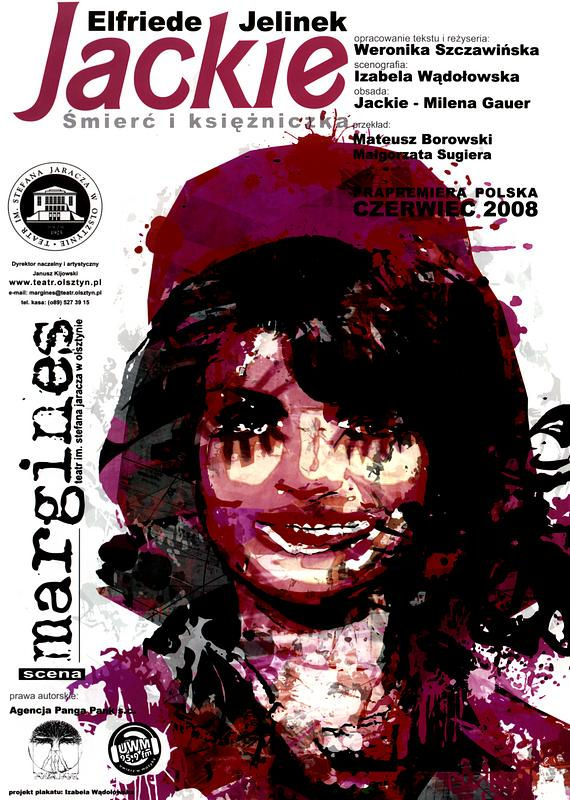
Jackie. Śmierć i księżniczka (Jackie: Death and the Princess) uses the figure of Jacqueline Kennedy, widow of the assassinated US president, to show a woman trapped within the image of the perfect wife, fashion icon, and guardian of national memory. In Milena Gauer’s monodrama, Elfriede Jelinek’s rhythmic text collides with the actress’s disciplined body, while the pink costume changes from a symbol of elegance into an instrument of oppression. The production reveals the violence of a culture that deprives a woman of her voice and turns her life into a reproducible image.
“Do princesses, then, have bodies? Can they bleed? Do they use tampons? Can they miscarry? What lies beneath the sugar coating of an immaculate image? The production [...] is essentially a series of collisions between the fantasy of the princess and a corporeality that tears it open from within and crushes its foundations. Szczawińska’s princess is nothing more than a self-assembly model, one whose construction requires murderous labour. We therefore do not observe Jackie Kennedy as an icon of style and fashion, but discover how such an icon is fashioned through a series of supposedly natural forms.”
— Paweł Sztarbowski, Stygmatyczka, “Didaskalia. Gazeta Teatralna” 2008, no. 87, pp. 52–53, (SOURSE)
“At the end, she tidies up while humming the American national anthem, sweeps the floor, puts away the props, and laboriously constructs a large upright box from everything onstage, before shutting herself inside. All the elements of the set prove to fit together: one box slots into another, while the metal frame gains walls made from cardboard silhouettes and sheets with openings. Illuminated inside the box, Jackie resembles a Barbie doll modelled on the First Lady.”
— Joanna Targoń, Jackie cały czas się krząta, “Gazeta Wyborcza – Kraków” 2008, no. 275, 25.11.2008. (SOURSE)
(INSTITUTION)
SINCE 2005
Theatre 21
Theatre 21 changed not only how disability is represented in Polish theatre, but also how the professional actor and co-author of a performance are understood. Founded in 2005 by Justyna Sobczyk, the company consists primarily of people with Down syndrome and autistic people. It developed from a workshop at a Warsaw school into a participant in the professional institutional circuit, challenging entrenched criteria of professionalism. Its method is based on long-term work involving improvisation, conversation, and the performers’ experiences. Disability is neither a role nor a metaphor here, but a concrete bodily experience subjected to judgement, care, and control.
The production PokaZ appropriated the convention of the freak show to expose a gaze that reduces people with disabilities to objects of pity or admiration. Libido romantico addressed sexuality and the right to adulthood, while Rewolucja, której nie było (The Revolution That Wasn’t) referred to the 2018 protest in the Polish parliament.
Theatre 21 does not treat the stage as a therapeutic space, but confronts spectators with their habits of looking. By establishing the Centre for Inclusive Art, it extended the struggle for visibility to authorship, paid work, and participation in institutional decision-making. The company demonstrated that presence onstage is only the beginning of change.

Why "21"?
The number 21 in the company’s name refers to the additional twenty-first chromosome that causes Down syndrome. From the outset, the name was a gesture of identity and opposition to concealing disability.
A Historic Passport Award
In 2021, Theatre 21 received the “Polityka” Passport. For the first time in the award’s twenty-eight-year history, it honoured artists with intellectual disabilities.
Seventeen Years Without a Home Stage
For its first seventeen years, the company worked without a stage of its own and appeared as a guest at various institutions. It gained a permanent home in Warsaw’s Praga district only with the opening of the Centre for Inclusive Art in 2022.
(PERFORMANCE)
2010
Mt 9,7

Mt 9,7 is an autobiographical lecture-performance in which Rafał Urbacki intertwines the experience of disability, queer identity, and a Catholic upbringing. Using his own body, movement, and irony, he challenges religious narratives of miracles and mercy as well as stereotypical ways of speaking about people with disabilities.
“The point of departure for the critical revision of prevailing perceptions of disability proposed by the production was Urbacki’s decision to stop using the wheelchair in which he had moved for more than a decade because of myopathy and progressive muscular atrophy. The fact that the performer ‘rose and walked,’ in accordance with the passage from the Gospel of Matthew cited in the title, was not a biblical miracle—the paradigm into which others repeatedly attempted to inscribe him—but the result of arduous work with the body. Urbacki could again move on his own legs, although they lacked sensation, thanks to a walking method of his own inspired by Body-Mind Centering and contact improvisation.”
— Justyna Szczepaniak, 25xXXI. Spektakle ćwierćwiecza: MT 9,7, “Teatr” 2025, no. 12, (SOURSE)
“A man in a wheelchair winds a music box, which plays a sentimental melody. The performer traces a heart in the air and gestures towards the audience. He attempts to establish direct contact with the spectators. It would be a touching image were the music box not a plastic figure of the Virgin Mary and the man’s face not marked by a mischievous smile. From the outset, Rafał Urbacki manipulates the spectators, feeding us the line that his solo performance is solely a story about disability and exclusion.”
— Katarzyna Lemańska, Cynik z różańcem wokół stopy, “Nowa Siła Krytyczna,” 23.08.2012. (SOURSE)
(PERFORMANCE)
2015
Śmierć i dziewczyna

Śmierć i dziewczyna (Death and the Maiden), based on three of Elfriede Jelinek’s Princess Plays and invoking motifs from The Piano Teacher, tells the story of a woman subjected to familial discipline, artistic rivalry, and violence. Marciniak juxtaposes fairy-tale figures of femininity with live music, choreography, and images of sexual objectification, revealing the price of imposed perfection. The participation of pornographic performers provoked protests and a call from the minister of culture to cancel the premiere, making the production a major point of contention over artistic freedom in Poland.
“Either desire or death. This dichotomy accompanies the heroines of Ewelina Marciniak’s latest production based on texts by Elfriede Jelinek. Yet the dichotomy proves only apparent, because desire ends in defeat and appears as a gesture bringing women closer to self-destruction. Desire is not a source of energy and does not culminate in physical fulfilment, but is a destructive force.”
— Marta Bryś, Zderzenie z rzeczywistością, “Dwutygodnik.com” 2015, no. 173, 21.11.2015. (SOURCE)
“Everything is ambiguous here. Three grand pianos continually manoeuvred across the stage are machines for producing pleasure and sophisticated torture. A tidy bourgeois kitchen can become the setting for wild sexual fantasies. An ordinary fold-out sofa becomes the Procrustean bed of two women locked in a destructive embrace. The parade of beautiful forms flowing across the stage also has a double face, because this beauty serves no purpose. Truth must be sought at its antipodes.”
— Jolanta Kowalska, Jazda figurowa na śmierć, “Teatr” 2016, no. 1. (SOURCE)
(Key event)
2016
The Black Protest

Czarny protest inicjatywy Ratujmy Kobiety w Warszawie; Ratujmy Kobiety; Konto na chwilę; Konto na chwilę, CC BY-SA 4.0; 2016.
In 2016, Black Monday combined opposition to an almost total abortion ban with a mass gesture of refusal. Dressed in black, participants stayed away from work, closed businesses, and took to the streets; the Sejm rejected the bill soon afterwards. Black clothing, umbrellas, and empty workplaces created a simple language of protest that returned in later mobilisations.
Theatre also became part of the protest. Krystyna Janda cancelled a performance of Maria Callas. Master Class, while the actresses in Żony stanu, dziwki rewolucji, a może i uczone białogłowy (Wives of the State, Whores of the Revolution, or Perhaps Learned Ladies) handed placards to spectators and led them outside the building. The stage joined the street in the struggle for bodily autonomy.

7 January 1993
Act restricting access to abortion
The act limited legal abortion and established the arrangement later described as the “abortion compromise.” It explains why the 2016 bill was regarded as a further tightening of an already restrictive law.

20 March 2007
European Court of Human Rights judgment in the case of Alicja Tysiąc
The Court found that Poland had failed to provide an effective appeal against the refusal of an abortion permitted on health grounds. The judgment exposed the difference between a right written into law and actual access to the procedure.

22 October 2020
Constitutional Tribunal judgment on abortion
The Tribunal removed severe and irreversible foetal impairment as grounds for legal abortion. The decision provoked mass demonstrations that developed the Black Monday model of mobilisation and its visual language.
(ARTIST)
Maja Kleczewska
Maja Kleczewska treats the body as a site where society inscribes its demands and determines what counts as normal, healthy, and permissible. In her theatre, norms operate through the family, medicine, and culture, influencing movement, speech, and self-perception.
She presents the conflict between personal experience and an imposed role through the actors’ intense presence, music, and interpenetrating stage and film images. In Fedra (Phaedra), desire violates the familial order, while Pod presją (Under Pressure) portrays a woman deemed ill because she cannot meet social expectations.
In Kleczewska’s later productions, the body increasingly becomes an instrument of political resistance. Bachantki (The Bacchae), staged in a space resembling a parliament, combined ancient tragedy with contemporary women’s protests against violence and restrictions on reproductive rights. In Dziady (Forefathers’ Eve), the director cast a woman as Konrad, the Romantic poet and symbol of the Polish national community. The body does not illustrate the text here, but changes its meaning: it reveals exclusions inscribed within tradition and allows people who were previously unable to speak on behalf of the community to make their voices heard.

Maja Kleczewska; Wrocławski Dom Literatury / Klub Proza; Rafał Komorowski; Rafał Komorowski, CC BY 4.0; 2024.
Before becoming a director, Maja Kleczewska studied psychology. Mental crises, social roles, and mechanisms of control frequently recur in her productions.
After the premiere of Adam Mickiewicz’s Dziady, the Małopolska education superintendent officially advised schools not to see the production, describing it as anti-government.
In 2023, during the continuing war and threat of air raids, Kleczewska created a Ukrainian-language Dziady in Ivano-Frankivsk. In this version, the protagonist was a man identified with the contemporary soldier.
(PERFORMANCE)
2017
Cezary idzie na wojnę

Cezary idzie na wojnę (Cezary Goes to War) is a musical and choreographic narrative that uses humour and the autobiographical experience of a military medical examination to challenge traditional models of masculinity. The production reveals how the state disciplines the body through military drill and patriotic myths.
“The hour-long performance queers the discipline imposed upon the male body—the body that should remain perpetually ready to fight. Physicality is subjected here to a humorous remix and the force of unpredictability. [...] Tomaszewski was concerned not so much with the temporality of war as with the dynamics of rejection and the speculative possibilities surrounding his own biography. The young Cezary received category E from the Military Recruitment Command: he was deemed permanently and completely unfit for service. In the production, the artist returns to this event and asks those who made the decision to reconsider his case.”
— Marcelina Obarska, 25xXXI. Spektakle ćwierćwiecza: Cezary idzie na wojnę, “Teatr” 2025, no. 12. (SOURCE)
“The male rite of passage—the recruitment of conscripts for military service—is transformed into a homoerotic anti-war manifestation that exposes the ideological emptiness and falsehood of mindless militarism. Moniuszko’s songs, liberated from national and patriotic ideology, reveal pure beauty and profound meaning. The confrontation of banal behaviour with great art naturally provokes laughter. Yet the production does not turn into vulgar cabaret, because every song and physical action is executed perfectly.”
— Mirosław Kocur, Analiza ramowa, “Teatralny.pl,” 28.03.2018. (SOURCE)
(KEY CONCEPT)
Biopolitics
Biopolitics describes a way of managing life in which power operates not only through prohibitions and punishment, but also through care, examination, and risk assessment. The same actions may protect health while also deciding who is able, safe, and entitled to participate in the community.
In Poland after 1989, this can be seen in disputes over access to treatment, reproductive rights, and border protection. Theatre can expose these mechanisms, but also arranges bodies itself, controls their presence, and distributes the right to speak. The concept of biopolitics therefore helps us perceive not a single oppressor, but a network of decisions through which some lives receive support while others are deemed less worthy of protection.
Questions to consider
How can one describe thousands of people affected by a crisis without reducing their experiences to statistics?
Questions to consider
How does theatre organise the bodies of spectators and performers by assigning them places, time, and rules of conduct?
Questions to consider
Who decides which bodies are regarded as healthy, able, or threatening?
CHAPTER 03
BODIES IN PROTEST
2018 – 2021
Mental health, disability, reproductive rights and sexual violence increasingly entered public debate. Protesters and artists demanded the right to speak for themselves rather than being represented by institutions, families or experts.
(PERFORMANCE)
2018
Pod presją

Pod presją (Under Pressure), inspired by John Cassavetes’s film A Woman Under the Influence, portrays Mabel, a wife and mother experiencing a mental crisis, whose family attempts to force her behaviour into its conception of a “normal” woman. The action unfolds simultaneously onstage and on screens, where live camera images intertwine with recordings to create a multiple, intimate portrait of the protagonist. The production asks where care ends and violence begins, and who has the right to draw the boundary between difference and illness.
“In the devastating final scene, Mabel returns from hospital and attempts to ‘speak normally,’ as her husband instructs her. She tries to attune her sensitivity to the social model, but this is perceived as an incomprehensible performance. For a long time, we see her face motionless, her eyes slightly narrowed and fixed on the light, as though she saw everything clearly. Theatre is born not from comfort but from discomfort, Kleczewska says in her message. We can begin to debate the reality of oppression materialised onstage.”
— Magdalena Legendź, Presja, “Teatr” 2018, no. 6. (SOURCE)
“In the lower part of the stage, we see the Longhettis’ realistic apartment. Above it is a large screen showing events in their home filmed by several cameras, as well as videos that provide a different perspective on the reality unfolding on the ‘lower level.’ Because Mabel is unquestionably the principal character, these films appear to show her point of view, as projections of her tormented soul descending into the abyss of madness. Combined with the music, they become the protagonist’s own ‘language,’ through which she tells us an alternative story in opposition to a cruel and violent reality.”
— Tomasz Domagała, Opowieść o zwyczajnym szaleństwie – „Pod presją” w reż. Mai Kleczewskiej w Teatrze Śląskim w Katowicach, “DOMAGALAsieKULTURY,” 26.03.2018. (SOURCE)
(Key event)
2018
Protest by People with Disabilities and Their Carers
%2C_maj_2018_.jpg)
Protest w obronie praw osób niepełnosprawnych, Plac Wolności we Włocławku; Stowarzyszenie Osób Niepełnosprawnych „Integracja”; Mariochom; Mariochom, CC BY-SA 4.0; 2018.
In 2018, people with disabilities, their mothers, and carers protested inside the Sejm for forty days. They demanded a higher social pension and a supplement paid in cash, but only the first demand was met. Their presence changed the public image of disability.
Adults previously represented as passive dependants spoke for their own rights, while a grey curtain separating them from part of the parliamentary corridor became a symbol of exclusion. Theatre 21 addressed this dispute in Rewolucja, której nie było (The Revolution That Wasn’t). Using banners and letters left after the protest, the company created a production about reclaiming one’s voice rather than helplessness.

19 March–4 April 2014
Parents’ protest in the Sejm
Parents and their children occupied the Sejm for seventeen days, demanding an increase in the carer’s allowance. The action preceded the 2018 protest but focused public attention on carers’ labour.

16 September 2015
First Congress of People with Disabilities
Nearly four hundred people met in Warsaw to discuss the implementation of rights guaranteed by the UN Convention. The congress reinforced the principle “nothing about us without us,” presenting people with disabilities as experts on their own lives.

1 January 2024
Introduction of the support benefit
The new benefit began to be paid directly to adults with disabilities according to the assessed level of support they required. It shifted the emphasis from financing carers to recognising the agency of the person receiving assistance.

(VOICE)
Justyna Sobczyk
Director and founder of Theatre 21
“We want to intervene consciously in a system that, while developing theatre and the performing arts, has eliminated non-normative people—especially people with disabilities—from them. We can see the consequences of separating certain groups from the mainstream and how narrowly we think about biodiversity. Social fear of disability means that, in art or arts education, we do not take risks at the human level. In theatre, we still prefer to ‘tell stories about.’ This is not enough to bring about the social change we care so deeply about, as demonstrated by numerous street protests, disappointment with the system, lack of social trust, and the absence of a sense of security. In theatre, we need to recover voices, presences, and bodies that society has hidden. There is no better place for this—apart, of course, from everyday life.”
Dominik Gac, Odzyskać ukryte, interview with Justyna Sobczyk, “Teatralny.pl,” 10.12.2021. (SOURCE)
(Key event)
#MeToo in Theatre
.jpg)
Teatr Bagatela im. Tadeusza Boya-Żeleńskiego, Kraków; Teatr Bagatela im. Tadeusza Boya-Żeleńskiego; Luxetowiec; Luxetowiec, CC BY-SA 3.0; 2013.
Poland’s theatrical #MeToo movement transformed private memories of violence into a public conversation about the system. Successive testimonies challenged the belief that actors should be unconditionally available and that directors or teachers may violate their boundaries in the name of art.
Conduct once explained as the temperament of a master began to be recognised as abuses of power. The debate also concerned how harm should be reported and how allegations should be handled, but above all it changed the language of rehearsals. Consent, the right to refuse, and safe working conditions ceased to be optional additions and became part of theatrical practice.

1 January 2004
Inclusion of workplace bullying in the Labour Code
The amendment defined workplace bullying as sustained harassment or intimidation and obliged employers to respond. It provided a legal language for describing abuse, but did not cover the many theatre workers without employment contracts.

20–21 June 2009
First Congress of Polish Women
The gathering brought together representatives of civic organisations, politics, culture, and business. It strengthened networks that made it possible to present discrimination, inequality, and violence as systemic problems.
_(Women's_rights_are_human_rights)_edited.jpg)
1994
Establishment of the Centre for Women’s Rights
The foundation began providing free legal and psychological support to women experiencing violence and discrimination. It created a support structure for testimonies previously dismissed as private matters.
CHAPTER 04
CARE, CONSENT AND VULNERABILITY
2022–2025
Theatre increasingly turns towards dying, ageing, exhaustion, pregnancy and physical safety. At the same time, new working practices challenge the belief that artistic intensity requires pain, coercion or unlimited availability.
(PERFORMANCE)
2022
Śmierć Jana Pawła II
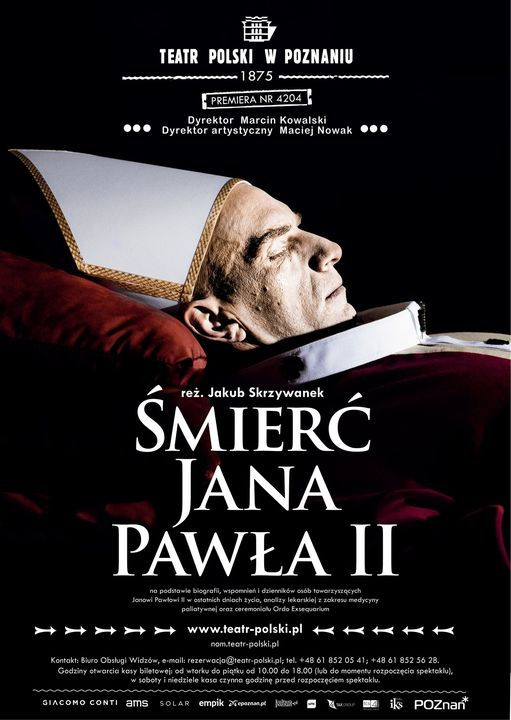
Śmierć Jana Pawła II (The Death of John Paul II) is a story about dying, mourning, and the social rituals surrounding the death of one of the most important figures in contemporary Poland. Skrzywanek juxtaposes collective memory with the physical experience of a dying body, asking questions about dignity, care, and the limits of experiencing death in public.
“For more than an hour, the actor Michał Kaleta enacts the death throes of a figure four decades older than himself. The production was developed in consultation with specialists in medicine and Catholic liturgy, while displayed documents point to a particular account of Karol Wojtyła’s dying. The performance aspires to reconstruction: the doctors onstage address the onstage Archbishop Dziwisz in Italian, and these exchanges are not translated. Medical equipment stands onstage; we are in the papal apartments. The media spectacle takes place somewhere outside, skilfully managed by Vatican decision-makers.”
— Witold Mrozek, Papież umiera, “Dwutygodnik.com” 2022, no. 331, 2.04.2022. (SOURCE)
“Anyone expecting a sensation will be disappointed. The creators of Śmierć Jana Pawła II avoid judging Karol Wojtyła’s pontificate, although they are not uncritical of the Catholic Church. They are interested in the unusual situation in which the Vatican, a powerful institution, must confront the mortality and corporeality of a person whom it treats as a symbol of its greatness. The question of empathy towards a dying human being concerns them, which is why they conduct a vivisection of death onstage.”
— Julia Niedziejko, „Śmierć Jana Pawła II”: Niezręczność umierania, “Krytyka Polityczna,” 12.02.2022. (SOURCE)
(VOICE)
Weronika Szczawińska
Director, dramaturg, and cultural scholar
How, then, should old age not be discussed in theatre? What mistakes should be avoided?
“What I would definitely try not to do is state categorically that older people ‘are like this or that’ and that old age ‘is this or that.’ To me, old age is a kind of story into which one can inscribe oneself or other people. Any excessive generalisation will therefore prove patronising and harmful. Naturally, it is difficult to escape all images and cultural representations. For art, even a stereotype can provide creative nourishment, something I have used many times myself. Yet the ready-made patterns offered by culture should become no more than elements of a production that we arrange, dismantle, emphasise, and challenge in different configurations.”
Henryk Mazurkiewicz, Starość jest pewną opowieścią, interview with Weronika Szczawińska, “Teatr” 2023, nos. 7–8, (SOURCE)
(PERFORMANCE)
2023
Jak nie zabiłem swojego ojca i jak bardzo tego żałuję

Jak nie zabiłem swojego ojca i jak bardzo tego żałuję (How I Did Not Kill My Father and How Much I Regret It) is an autobiographical account of illness, dying, and the relationship between a son and his father. It intertwines personal experience with the question of euthanasia and the right to a dignified death—an especially pressing issue in Poland, where euthanasia is prohibited by law.
“This production also says a great deal about those accompanying the dying. Because of the law in force—apparently immovable because of the Church and its orthodox acolytes—they cannot relieve either the sick person’s suffering or their own. They must submit helplessly to the callousness and tendency to humiliate displayed by representatives of the healthcare system. Fortunately, the writer and director permits his characters—including the men—a form of catharsis expressed through tears. There are also moments of black humour that provide a brief respite on both sides of the footlights in this production saturated with extreme emotions.”
— Krzysztof Krzak, Jak ojciec umierał…, “Teatr dla Wszystkich,” 26.08.2024. (SOURCE)
“The script grew from an autobiographical essay resembling an intimate diary. It is a detailed account containing a mass of particulars about what it is like to die of pancreatic cancer in Poland. It is a chronicle of self-observation, recorded with the sensitive and precise instrument that is the pen of Mateusz Pakuła—playwright, dramaturg, and director. Writing probably helped him survive. After all, what can a writer do in this unequal war but write? In order not to go mad, to tame things through laughter, and to force the incomprehensible out of oneself into rows of letters.”
— Grzegorz Kondrasiuk, Fakty i trauma, “Do Rzeczy” 2024, no. 9, 28.02.2024. (SOURCE)
(VOICE)
Izabela Zawadzka
Dancer, educator, and choreographer
The persistence of certain myths surrounding work with the body is striking.
“A year ago, during Bartosz Kuc’s Flexibility & Mobility course, I learned that, even as a ballet-school student, I could have been stretched in a completely different and much healthier way. [...] The results showed that thirty seconds of static stretching performed daily for six weeks produced a significant increase in range of motion. [...] I was taught using Soviet methods, which meant holding a position for an hour or two. As a result, I cannot feel certain parts of my body today because I was stretched by force and my body disconnected from the experience. The knowledge was available, and teachers could have used it, but for various reasons they did not—certainly including difficulties of access. Today, access is completely different and a great deal of information can be found much more easily, including for free, yet we still stretch by force.”
Hanna Raszewska-Kursa, Wiedza wzmacnia, interview with Izabela Zawadzka, “Teatralny.pl,” 16.07.2025, (SOURCE)
(KEY CONCEPT)
The fatigue society
Fatigue in this sense does not mean an ordinary lack of strength or a medical diagnosis. It describes a culture in which people must continually increase their productivity, develop themselves, and remain available until rest begins to look like failure. It is not a synonym for burnout, but a broader description of a social problem.
In Poland after the political transformation, this pressure was intensified by employment insecurity, the promise of individual success, and later by permanent online presence. Theatre can represent exhaustion through rhythm and the body’s repeated effort, but it can also overburden performers itself. The concept becomes significant when it allows us to ask who may rest, whose fatigue remains invisible, and why the body’s limits are regarded as personal failure.
Questions to consider
How can theatre represent exhaustion without exposing performers to actual overwork?
Questions to consider
Why are fatigue caused by physical, caring, and creative labour judged differently?
Questions to consider
Whose rest is regarded as deserved, and whose inactivity is readily labelled laziness?
(PERFORMANCE)
2024
Dramat rodzaju męskiego
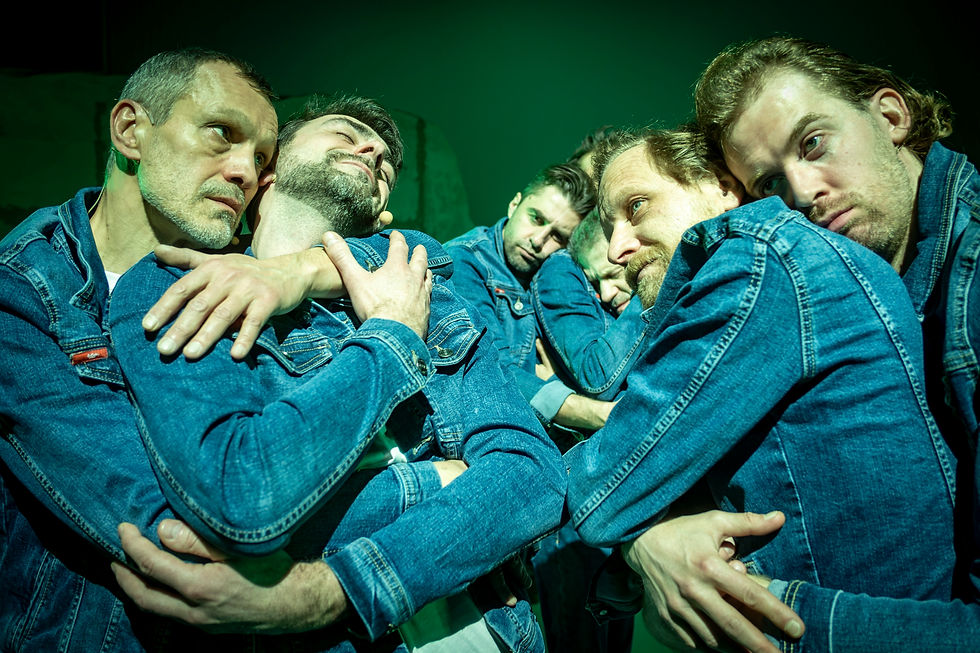
Dramat rodzaju męskiego (A Drama of the Male Kind), based on Jakub Tabaczek’s Stulejka (Phimosis), consists of episodes depicting masculinity at successive stages of life: from the relationship between father and son to crises, violence, and ageing. With humour, Liber dismantles the model of the unshakeable macho, using denim costumes, choreography, music by the band sneaky jesus, and a women’s chorus. The production shows how patriarchal roles pass between generations while searching for an alternative founded on tenderness, vulnerability, and empathy.
“The scene with a young man suffering from phimosis, who visits the Doctor with a motorbike, approaches cabaret. As part of the medical assistance package, the poor young man receives not only a workshop on how to address his own genitalia correctly, but also a fairly cruel initiation ritual that, he is assured, is essential for every owner of a ‘little prince.’”
— Henryk Mazurkiewicz, Męska kondycja, “Teatr” 2024, no. 3. (SOURCE)
“An important role in constructing the represented world was played by Mirek Kaczmarek, today one of the most distinguished and active theatre scenographers. Kaczmarek ridiculed the stereotype of the man who must build a house, plant a tree, and father a son. The house on the empty stage is a wretched wall, the tree a withered stump, and the son a dead doll. A headless, twisted mannequin of the male body remains downstage throughout the production and leaves no illusions about the condition of contemporary manhood.”
— Mirosław Kocur, Łebasy, czyli skazani na siebie, “Teatralny.pl,” 24.01.2024. (SOURCE)
(VOICE)
Ramona Nagabczyńska
Dancer, choreographer, and performer
What is it like to dance and perform while pregnant?
“The prevailing view today is that pregnant women should continue the physical activity they practised before pregnancy. They should not take up difficult and demanding disciplines—for example, begin training for a marathon if they did not run before becoming pregnant. One must ensure that the heart rate does not rise too high. I used a watch to check it. I ran a little while pregnant and performed several times. During my first pregnancy I reduced physical effort too much and experienced pain before and after giving birth. During my second pregnancy I moved more, which in retrospect makes me very happy. I do not know whether it was because of the movement or because it was my second pregnancy, but the birth was incomparably better—an enjoyable delivery without anaesthetic. I felt that my body was ready. A pregnant woman onstage is something wonderful! It is a pity that so few women choose to perform then. Naturally, safety must be ensured. When I could not perform certain movement sequences, another person took them over from me.”
Magdalena Ożarowska, Czy performerka może być mamą?, interview with Ramona Nagabczyńska and Iza Szostak, “Teatr” 2025, nos. 7–8, (SOURCE)
(Key event)
2019–2024
Intimacy Coordination
.jpg)
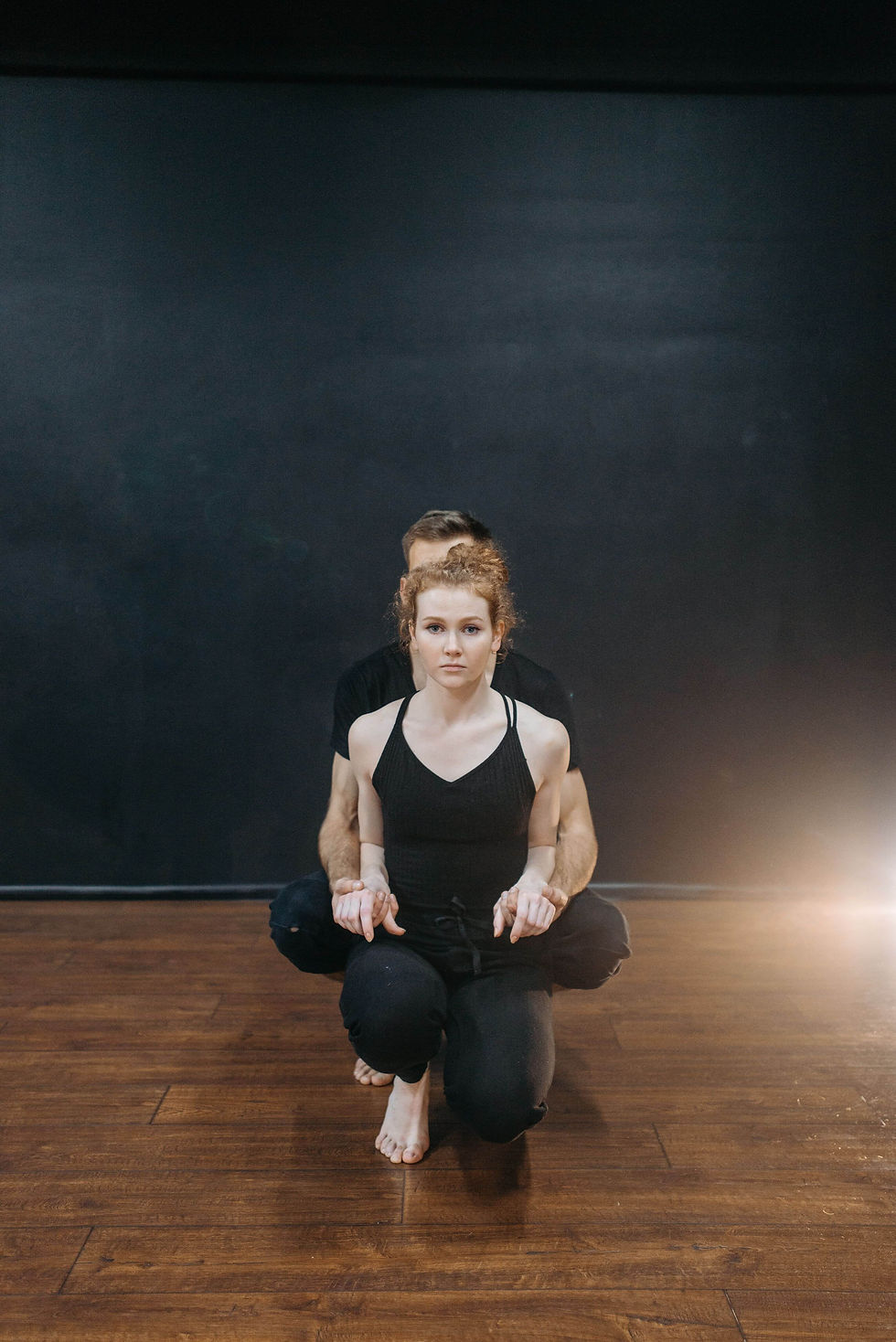
A kiss can be broken down into movements like a stage fight, defining touch, tempo, and the right to stop the scene. This is how intimacy coordination works: it does not deprive acting of passion, but separates a character’s emotions from a performer’s boundaries.
In 2024, three books published by Warsaw’s Aleksander Zelwerowicz National Academy of Dramatic Art summed up the Safe Space project and popularised practical principles for working with nudity and simulated sex. Responsibility ceased to rest solely with the actor and came to encompass the entire rehearsal process. The publications do not promise complete safety, however. They ask whether consent is genuinely free if refusal may mean losing a role, a grade, or a job.
6 November 2019
Disclosure of allegations at the Bagatela Theatre
Women working at Kraków’s public theatre accused its director of sexual harassment and workplace bullying, allegations he denied. The case revealed how professional dependence and a lack of procedures can sustain silence.

15–16 May 2021
Boundaries in Theatre project
Workshops and debates addressed violence, human rights, and the limits of the creative process. The Charter of Rights and Boundaries in the Creative Process translated demands for change into practical principles of collaboration.

25 September 2021
Premiere of Opowieści niemoralne
Intimacy consultants worked on Jakub Skrzywanek’s production. The widely discussed precedent demonstrated that nudity and simulated sexual violence can be prepared by negotiating consent and defining actions precisely.
(VOICE)
Natalia Lange
Actor
“Younger people need a clearly defined professional code of ethics to feel safe and regard it as the absolute minimum, while older people sometimes perceive it as censorship and a restriction on artistic freedom. For many years, the older generation was accustomed to extremely powerful stimuli, working on adrenaline, throwing themselves into improvisation without safeguards, and sometimes to a tense atmosphere at work. Now everyone is trying to name and structure everything. This is indeed a clash between two poles, but I think it is highly invigorating. We simply still have a great deal of work ahead of us in order to understand it and then develop new habits.”
Agata Adamiecka, Wyparte wróci, interview with Natalia Lange, “Teatr” 2025, no. 4, (SOURCE)